
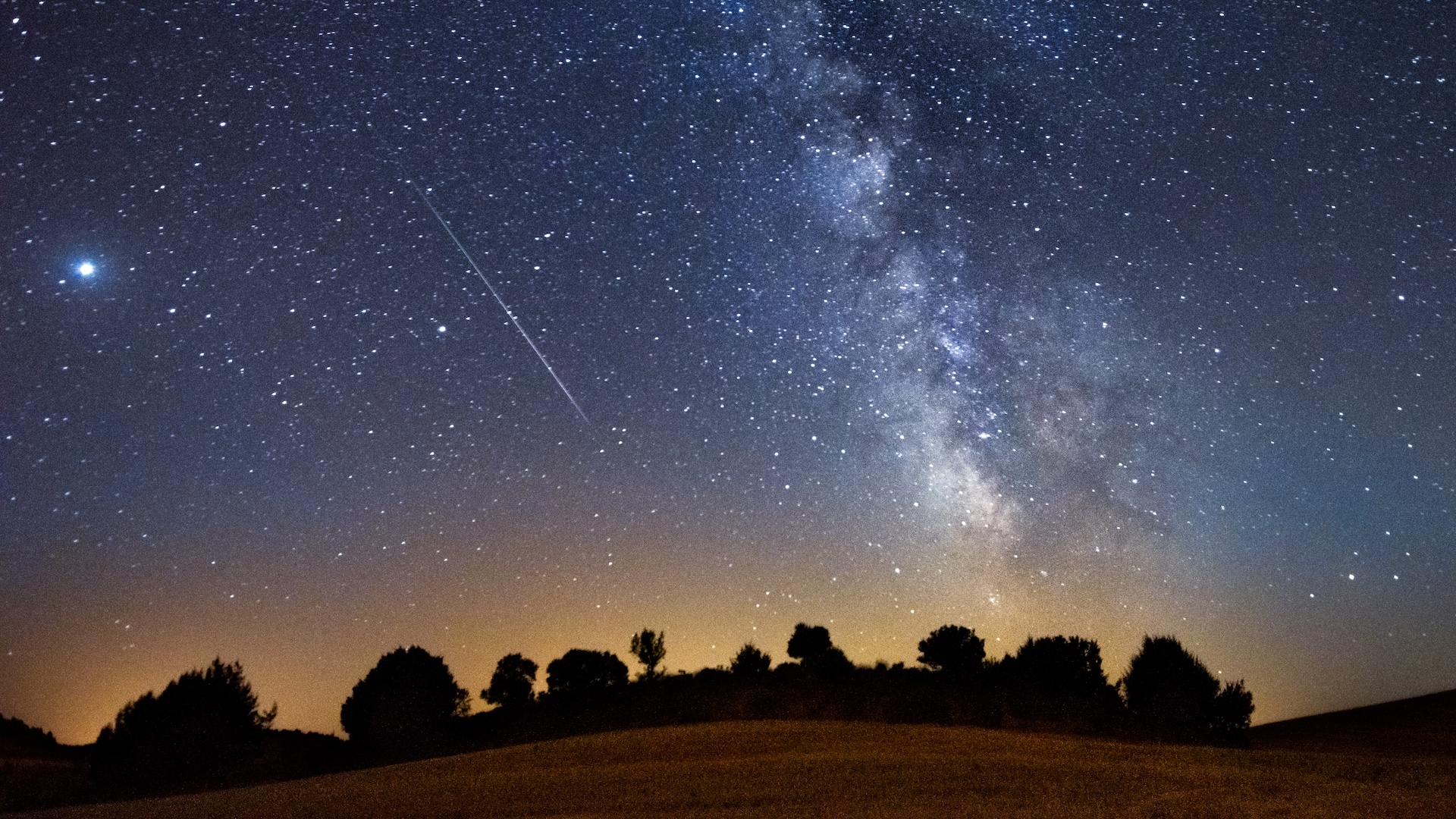
The annual Perseid meteor display is one of the best-known and commonly observed meteor showers in the Northern Hemisphere. But this year, if you want to enjoy the show, it's best to get in early.
The Perseids will be active from Thursday, July 17, through Saturday, Aug. 23 and will peak this year on Aug. 12 and 13. But the presence of a near-full moon will make this year's event disappointing, with only the very brightest shooting stars visible.
Typical advice for the peak of a major meteor shower is to head to a location with low levels of light pollution, such as a dark sky place or an area that appears dark on a light pollution map. However, with August’s full Sturgeon Moon on Saturday, Aug. 9, its light will bleach the night sky just as the Perseids' peak gets underway. On the night of the peak, a waning gibbous moon will rise a couple of hours before midnight and be 84% lit, shining brightly all night. It will effectively pollute the night sky with its light, making a trip to escape urban light pollution pointless.
Because of the moon's plan to steal the show, the best way to see the Perseids this year will be both before and after the peak nights. Although the rate of shooting stars will be much lower, there's a dark sky window — when moonlight is at a minimum — from July 18 to 28. That's because the half-lit last quarter moon on July 18 rises at midnight, there's a new moon on July 24, and only a weak crescent moon sets early until around July 28. After that, the waxing crescent moon will begin to interfere with shooting stars and there will be two weeks of bright moonlit nights.
After the peak, the waning gibbous moon will begin to move out of the way when it next reaches its last quarter phase on Aug. 16. Although the rates of shooting stars will be on the wane by that time, any clear nights that week should herald at least some views of the celestial light show.
Related: The 10 best stargazing events of 2025
The Perseid meteor shower is known for its fast and bright meteors, which move at a swift 37 miles per second (60 kilometers per second). They're the product of tiny particles left in the solar system by Comet 109P/Swift-Tuttle striking Earth's atmosphere. As they do, they heat up and vaporize, releasing energy visible as streaks of light in the night sky.
While conditions in 2025 are far from perfect, if you go stargazing when the moon is down — and even when it's up — you'll probably notice one or two of the year's most famous shooting stars.