

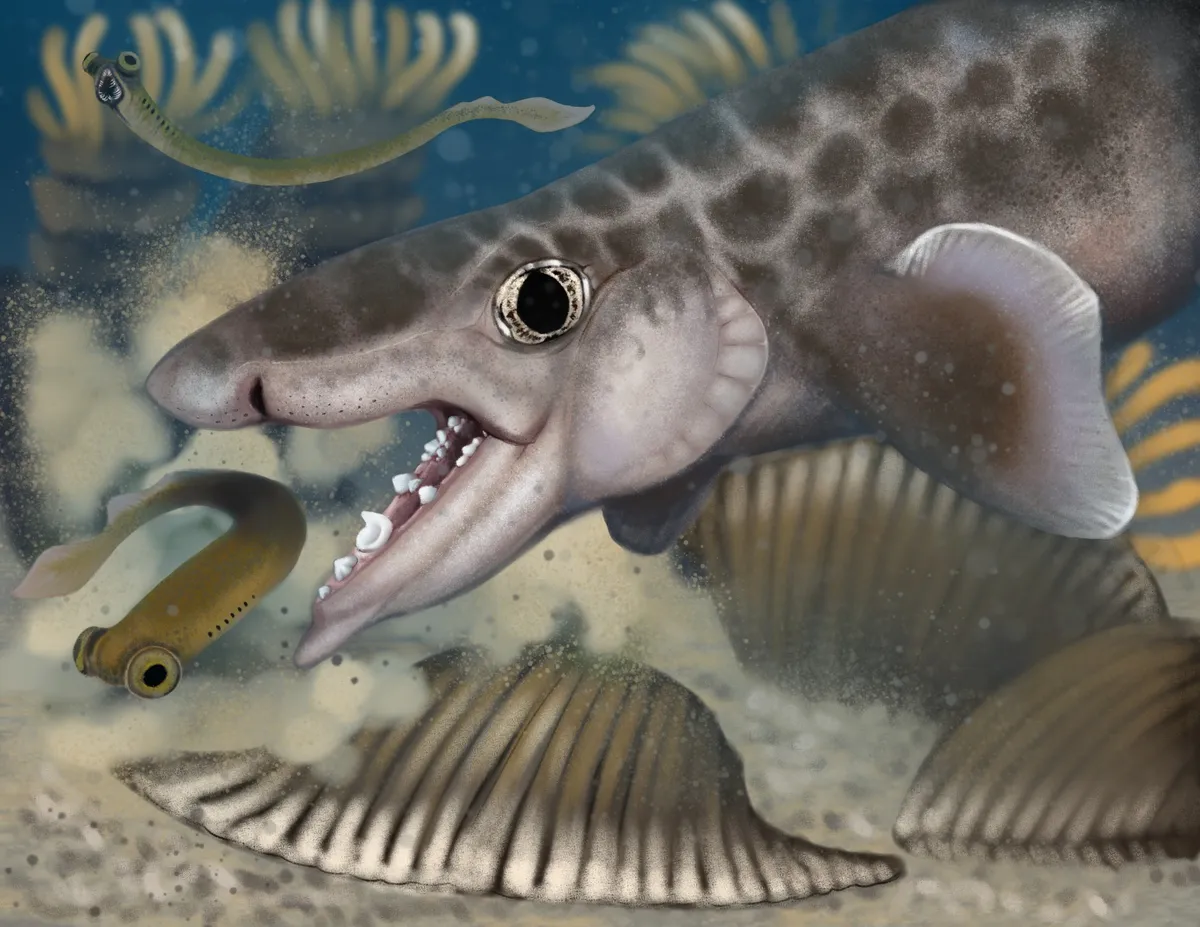
Researchers have discovered the remains of an ancient shark deep inside the world's longest cave system.
The newly discovered shark, plucked from the walls of Mammoth Cave in Kentucky, lived around 340 million years ago and was equipped with a curved row of teeth that it used for crushing its prey.
Macadens olsoni was a small shark, less than 1 foot (30 centimeters) long, and likely fed on mollusks and worms, according to a statement released by the National Park Service (NPS).
"This discovery is a remarkable addition to our understanding of ancient marine life and underscores the importance of preserving and studying our natural history," Barclay Trimble, the superintendent at Mammoth Cave National Park, said in the statement.
Related: 340 million-year-old 'nail tooth' shark found deep inside Mammoth Cave in Kentucky
The rocks of Mammoth Cave formed around 320 to 360 million years ago and were once beneath a shallow saltwater sea, called the Mississippian Sea. The cave system itself is much younger, and only formed about 10 to 15 million years ago, when water from rivers and streams on the surface sank into the rock and carved out the cave's passages found today, according to NPS.
The exact length of Mammoth Cave is unknown, but explorers have mapped more than 426 miles (686 kilometers) of it, and are still uncovering new passages. It hosts a treasure trove of ancient fish fossils — more than 70 different long-lost species have been identified within its walls so far.
The latest find was extracted from the Ste. Genevieve rock formation and dates back to the Carboniferous period (358.9 million to 298.9 million years ago). The genus name, "Macadens," honors Mammoth Cave, while the species name, "olsoni," honors Rickard Olson, a retired park scientist who has played a key role in documenting these fossils, according to the statement.
The M. olsoni discovery helps researchers better understand the ancient ecosystems now preserved in Mammoth Cave, which may have once been similar to reefs.
"This finding not only enhances our knowledge of ancient marine ecosystems but also emphasizes the critical role of paleontological research in our national parks," Trimble said. "Every discovery connects the past with the present and offers invaluable educational opportunities for students and the public."