
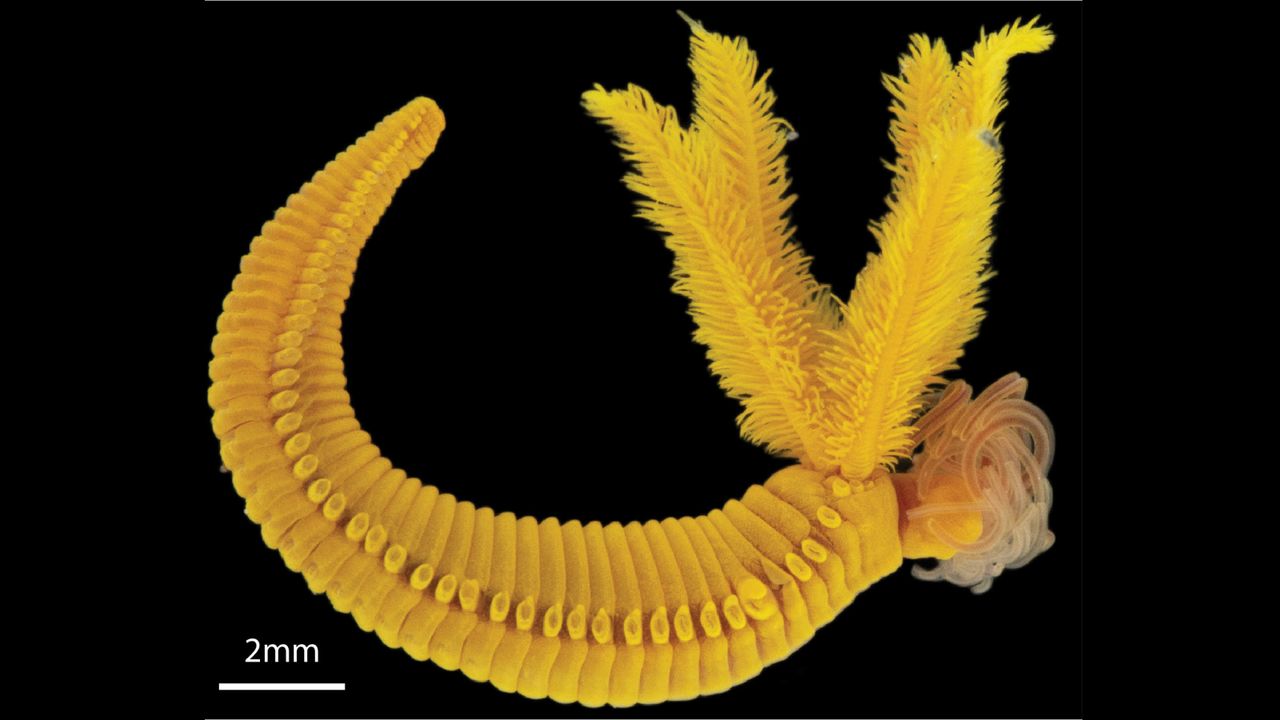
Deep-sea creatures are uniquely adapted to living in extreme environments, and the worm Paralvinella hessleri is no exception. In fact, it survives high levels of toxic chemicals like arsenic by creating its own poison.
Found only at the hottest hydrothermal vents in the western Pacific, including the Okinawa Trough and Mariana Back-Arc Basin, these worms grow up to about 0.8 inches (22 millimeters) in length and live in protective tubes attached to vent chimneys. Remarkably, P. hessleri is the only known animal able to colonize and thrive in the acidic, metal-rich zones of these vents, where temperatures can reach around 608 degrees Fahrenheit (320 degrees Celsius).
These worms have an unusual survival trick that lets them withstand the high levels of toxic arsenic and sulfide found at hydrothermal vents. In humans, arsenic exposure is linked to serious health problems, including cancer and neurological disorders. P. hessleri, however, turns this danger into a defense: it stores arsenic in its skin cells, where the toxin reacts with sulfide from vent fluids to form orpiment — a less harmful, though still poisonous, mineral.
This bright yellow-orange substance, once known as "King’s Yellow," was historically used by artists as a pigment until its toxicity became clear. P. hessleri, which has a yellow-orange tint due to the orpiment crystals, can accumulate so much arsenic that it makes up nearly 1% of the worm's body weight.
In a 2025 paper published in the journal PLOS Biology, the researchers who discovered the worms' survival strategy described the process as "fighting poison with poison."
Commenting on the discovery, study co-author Hao Wang, a researcher at the Chinese Academy of Sciences’ Institute of Oceanology, said he was "stunned" when he first saw the worms with a remotely operated vehicle.
"The bright yellow Paralvinella hessleri worms were unlike anything I had ever seen, standing out vividly against the white biofilm and dark hydrothermal vent landscape," he said in a statement. "It was hard to believe that any animal could survive, let alone thrive, in such an extreme and toxic environment."