
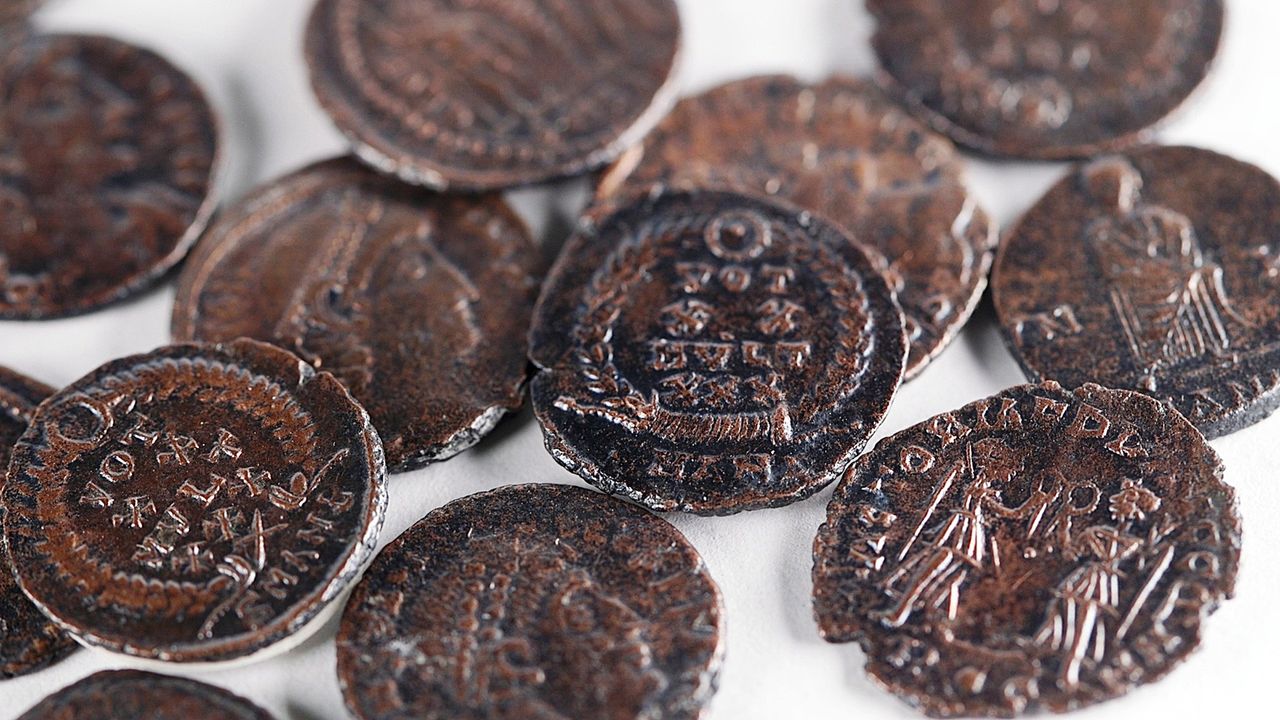
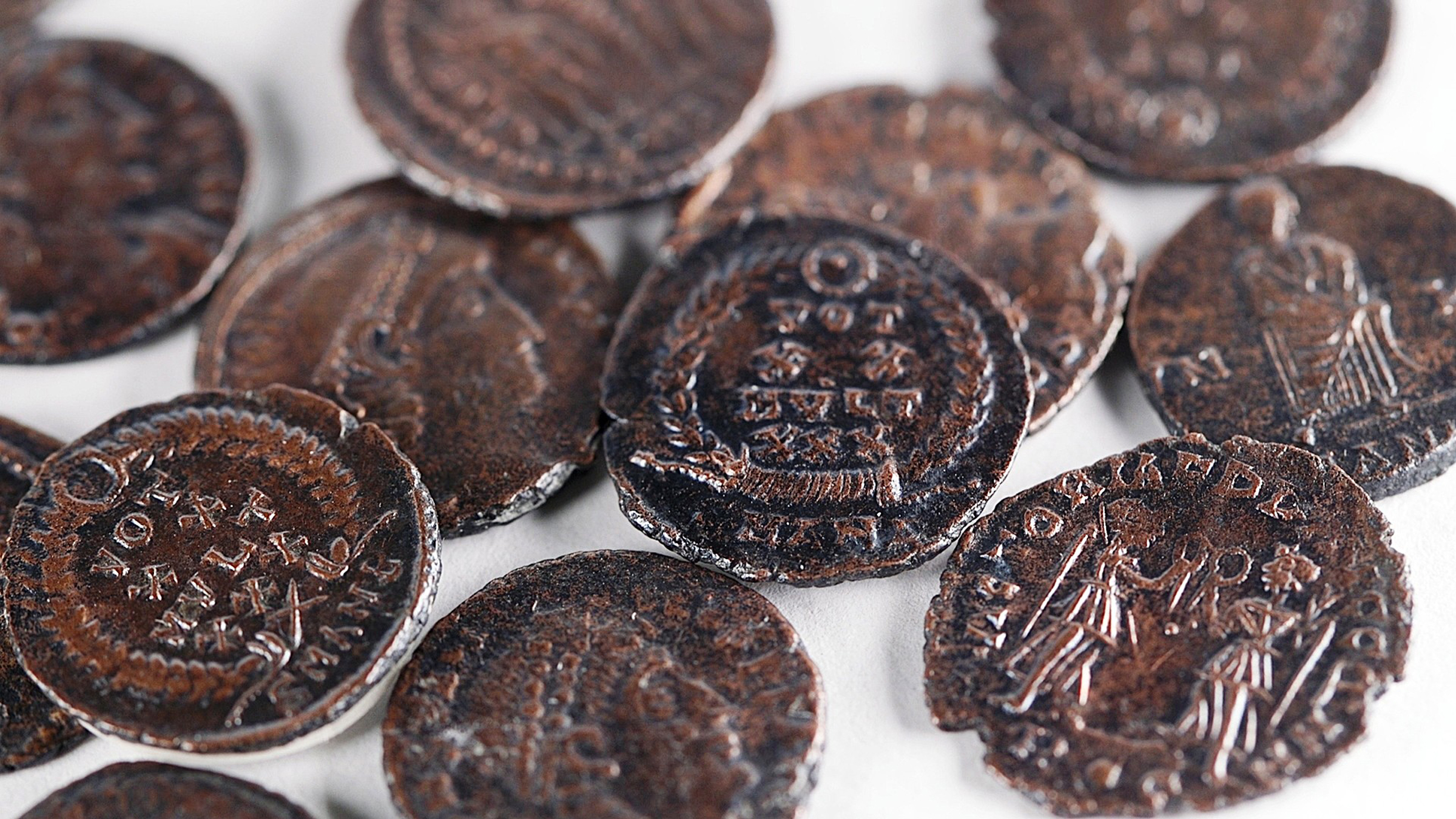
Archaeologists have unearthed a rare hoard of 1,600-year-old copper coins in Galilee, and the coins may have been stashed there during the last known Jewish revolt against the Romans.
Researchers found the 22 copper coins in a crevice within a tunnel complex deep underneath a settlement known as Hukok. The tunnels were used by Jews as a hiding place in two early rebellions against the Romans: the Great Revolt (A.D. 66 to 70) and the Bar-Kochba (also spelled Bar-Kokhba) Revolt (A.D. 132 to 135). However, the newfound coin hoard didn't date to either of those rebellions, the archaeologists found.
"This shows that hundreds of years after these tunnels were dug out, they were reused," Uri Berger, an archaeologist at the IAA, and Yinon Shivtiel, a professor at Zefat Academic College and an expert in cave archaeology, said in an IAA statement. "The hoard provides — in all probability, unique evidence, that this hiding complex was used in one way or another during another crisis — during the Gallus Revolt — a rebellion for which we have only scant historical evidence of its existence."
The tunnels and underground rooms, known as the Hukok hiding complex, enabled Jewish people to hide and perform everyday religious practices out of sight from the Romans.
"It seems that the people stashing this hoard carefully planned its hiding place, hoping to return to it when the threatening troubles were over," Berger and Shivtiel said in the statement. "The coins were discovered in a pit, deliberately dug at the end of a narrow winding tunnel."
Related: 2,100-year-old farmstead in Israel found 'frozen in time' after owners disappeared
The Romans had been in the Holy Land since 63 B.C., and the Jews revolted several times during Roman rule. The Gallus Revolt is named for Constantius Gallus, a "caesar" or statesman who ruled the Roman Empire's eastern provinces under Roman emperor Constantius II, who was his cousin. However, the revolt was unsuccessful, and the Romans burned and destroyed many of the Jewish people's cities.
The hoard's discovery will be analyzed in a study in an upcoming issue of the journal Israel Numismatic Research.
Roman emperor quiz: Test your knowledge on the rulers of the ancient empire