
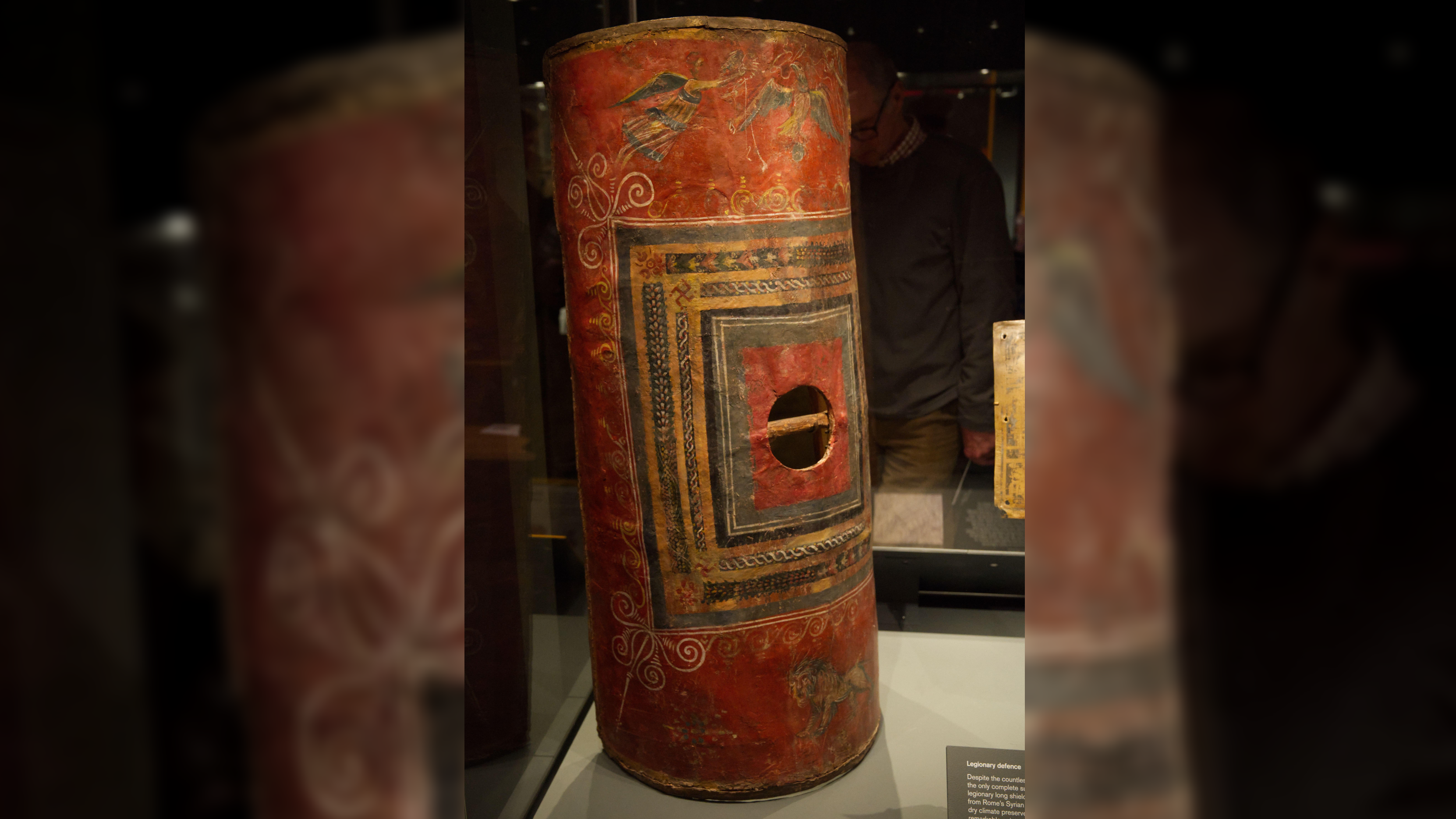

Name: Painted Roman scutum (long shield)
What it is: A wooden and leather shield used by a Roman soldier in battle
Where it is from: Dura-Europos, Syria
When it was made: Second century A.D.
Related: Babylonian tablet preserves student's 4,000-year-old geometry mistake
What it tells us about the past:
This tall, semi-cylindrical shield, which is in the collection of the Yale University Art Gallery, is one of the few surviving examples of a Roman "scutum," the most popular shield type from the fourth century B.C. to the third century A.D. It was excavated from the ancient city of Dura-Europos in Syria nearly a century ago, and probably belonged to a Roman soldier who lost his life in battle.
Few examples of this type of shield have survived over the millennia, even though it is well known from depictions in art. The Dura-Europos shield gives archaeologists a huge amount of information about how this piece of armor was made. Several layers of wood strips were laminated together to make a surface that was 41.5 inches (105.5 centimeters) tall, 16 inches (41 cm) wide, and about 0.2 inches (6 millimeters) thick. It had been shattered into 13 pieces and was missing its "umbo" or boss — a cup-shaped piece of material that would have protected the central hole where the soldier held onto the shield.
The front of the shield was covered with kidskin, then painted. According to the Yale University Art Gallery, "the painted decoration reflects Roman iconography of victory, including an eagle with a laurel wreath, winged Victories and a lion."
The shield was discovered by archaeologists in 1933 under a fortification tower during excavations at Dura-Europos. The Romans made Dura-Europos part of their empire in A.D. 165, using it as an eastern trading post. But the city was abandoned in A.D. 256 after being besieged by soldiers from the Sasanian Empire of ancient Iran.
Archaeologists found the skeletons of 19 Roman soldiers, complete with all their weapons and armor — including the scutum — in a tunnel under a fortification tower. While these soldiers may have simply been trapped by a collapsed tunnel, some experts think that the Sassanids were waiting for the Romans to break through. When they did, the Sassanids used naphtha — an ancient chemical weapon — to suffocate them.
After the battle with the Sassanids, residents fled, and Dura-Europos was swiftly reclaimed by the desert sands. It was not found until 1920, when American archaeologist James Henry Breasted recognized the name "Dura" on a Greek inscription on the ancient city's main gate.