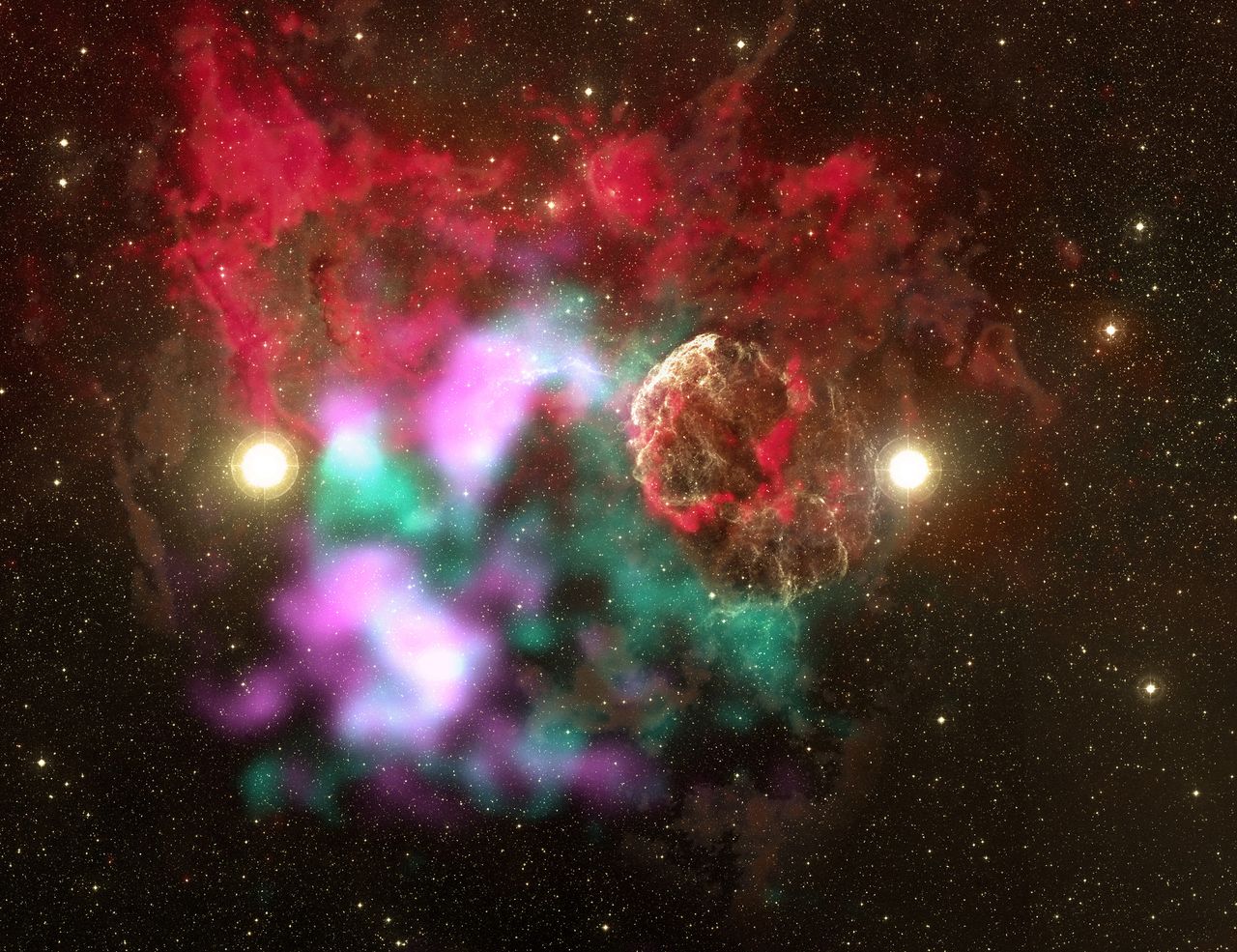
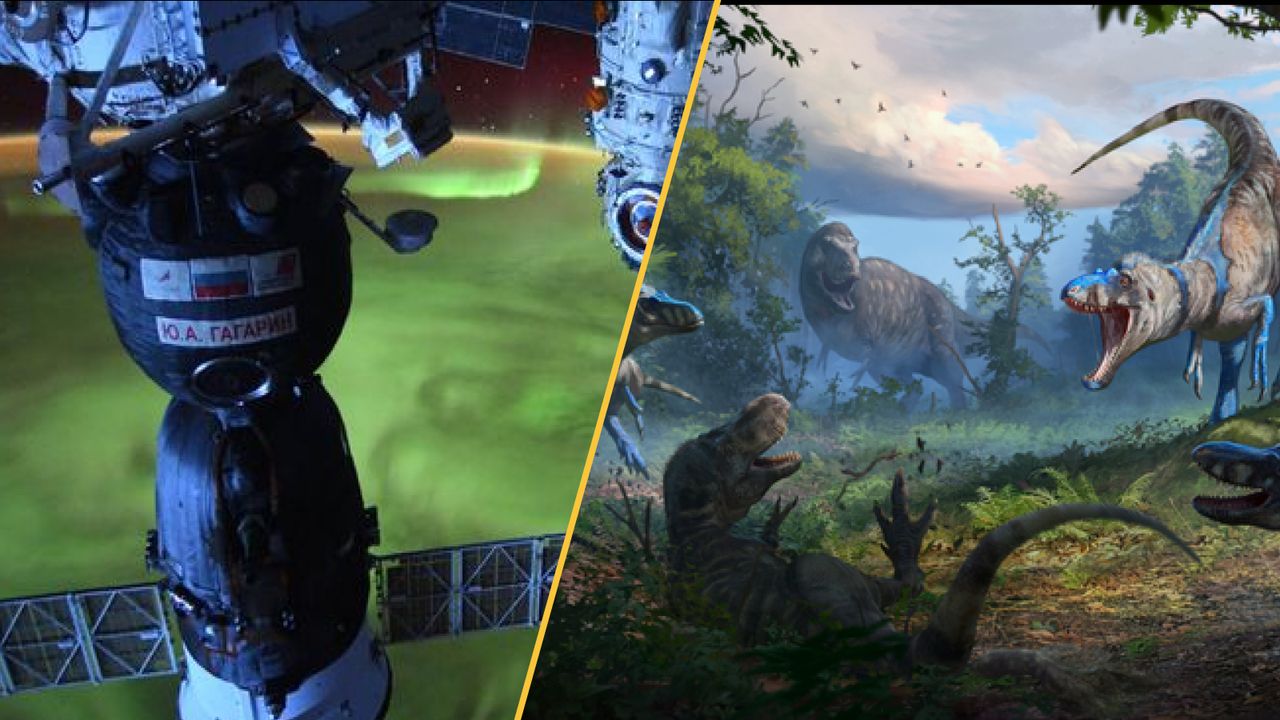
The hottest science news this week has revolved around the sun, with the arrival of some dazzling new studies concerning our star and the fascinating interstellar comet currently passing close to it.
To get us started, scientists have discovered a clue as to why the sun is so much hotter at its outer surface than inside its core. A new study revealed that magnetic waves — theorized since the 1940s yet only detected now — carry energy from the sun's inner furnace to its outer corona.
Nanotyrannus was real and not just a teenage T. rex

A remarkable fossil find has thrown lit dino-mite into a controversy about whether a mini-tyrannosaur was a young Tyrannosaurus rex or its own unique species. The debate has roared on for nearly four decades, but a fossil known as the "Dueling Dinosaurs" may have finally offered a conclusive answer. Unearthed in 2006, the fossils show a Triceratops who appears to be locked in battle with a fierce tyrannosaur.
Now, a jaw-dropping analysis of the "Dueling Dinosaurs" has revealed that the tyrannosaur likely wasn't a juvenile T. rex, as many experts had assumed, but a fully grown adult of a previously debated species called Nanotyrannus lancensis.
Following the find, paleontologists now largely accept that Nanotyrannus is its own species. But to confuse matters further, a separate team has also named a different new species in the genus — Nanotyrannus lethaeus. So does this mean the dust has finally settled? Or do paleontologists have a new bone to fight over?
Discover more animals news
—Lab monkeys on the loose in Mississippi don't have herpes, university says. But are they dangerous?
—First-ever 'mummified' and hoofed dinosaur discovered in Wyoming badlands
Life's Little Mysteries

Picture a Neanderthal at dinner and your mind's eye will likely conjure an image of one gnawing upon an enormous, prehistoric drumstick. But did our extinct cousins really only chow down on meat? Or did they eat their greens too?
—If you enjoyed this, sign up for our Life's Little Mysteries newsletter
Cussing out your chatbot makes it more accurate

Hate AI? You might be the best at getting it to work for you, according to a new study that found chatbots give more accurate answers when you're being mean to them. The difference in accuracy is fairly small, however, with a 4% improvement between prompts classed as very polite to those that are very rude.
The researchers nonetheless caution against this approach, as there's a chance that being truculent and ill-mannered to the bots could spill over to your behavior with fellow humans. If that's not a convincing enough reason on its own, consider the (almost impossibly small) chance that the bots could gain sentience — can you be sure they'll have forgotten what you said?
Discover more technology news
—Humanoid robots could lift 4,000 times their own weight thanks to breakthrough 'artificial muscle'
Also in science news this week
—Physicists detect rare 'second-generation' black holes that prove Einstein right ... again
Science Spotlight

The introduction of mRNA-based vaccines for COVID-19 was a key achievement during the previous Trump administration, swiftly curtailing the pandemic in the mere months the vaccines took to go from conceptualization to mass production.
Yet now the second Trump government appears bent upon undoing its previous work through funding freezes, mass layoffs and the scrapping of research projects into mRNA research.
As the U.S. government continues to divest from the technology, scientists are worried that the revolutionary treatments it offers for cancer, immune deficiencies and genetic disorders could be left behind. Live Science reported on mRNA research's uncertain future in the U.S. in this fascinating Science Spotlight.
Something for the weekend
If you're looking for something a little longer to read over the weekend, here are some of the best polls, interviews and opinion pieces published this week.
Would you get rid of daylight saving time? [Poll]
There is such a thing as 'settled science' — anyone who says otherwise is trying to manipulate you [Opinion]
Science in pictures

The James Webb Space Telescope served us a spooktacular treat for Halloween this week, capturing never-before-seen details of the Red Spider Nebula, its filaments twisting and stretching like the limbs of a gigantic arachnid.
Planetary nebulas such as this one form when stars like our sun reach the end of their lifetimes, expanding into red giants and shedding their outer layers to form shrouds of superheated dust. The cosmic spider's legs shimmer with molecular hydrogen, and the fragmenting gas outflows from the dying star give the cosmic limbs a distinctly hairy appearance.
Want more science news? Follow our Live Science WhatsApp Channel for the latest discoveries as they happen. It's the best way to get our expert reporting on the go, but if you don't use WhatsApp we're also on Facebook, X (formerly Twitter), Flipboard, Instagram, TikTok, Bluesky and LinkedIn.