

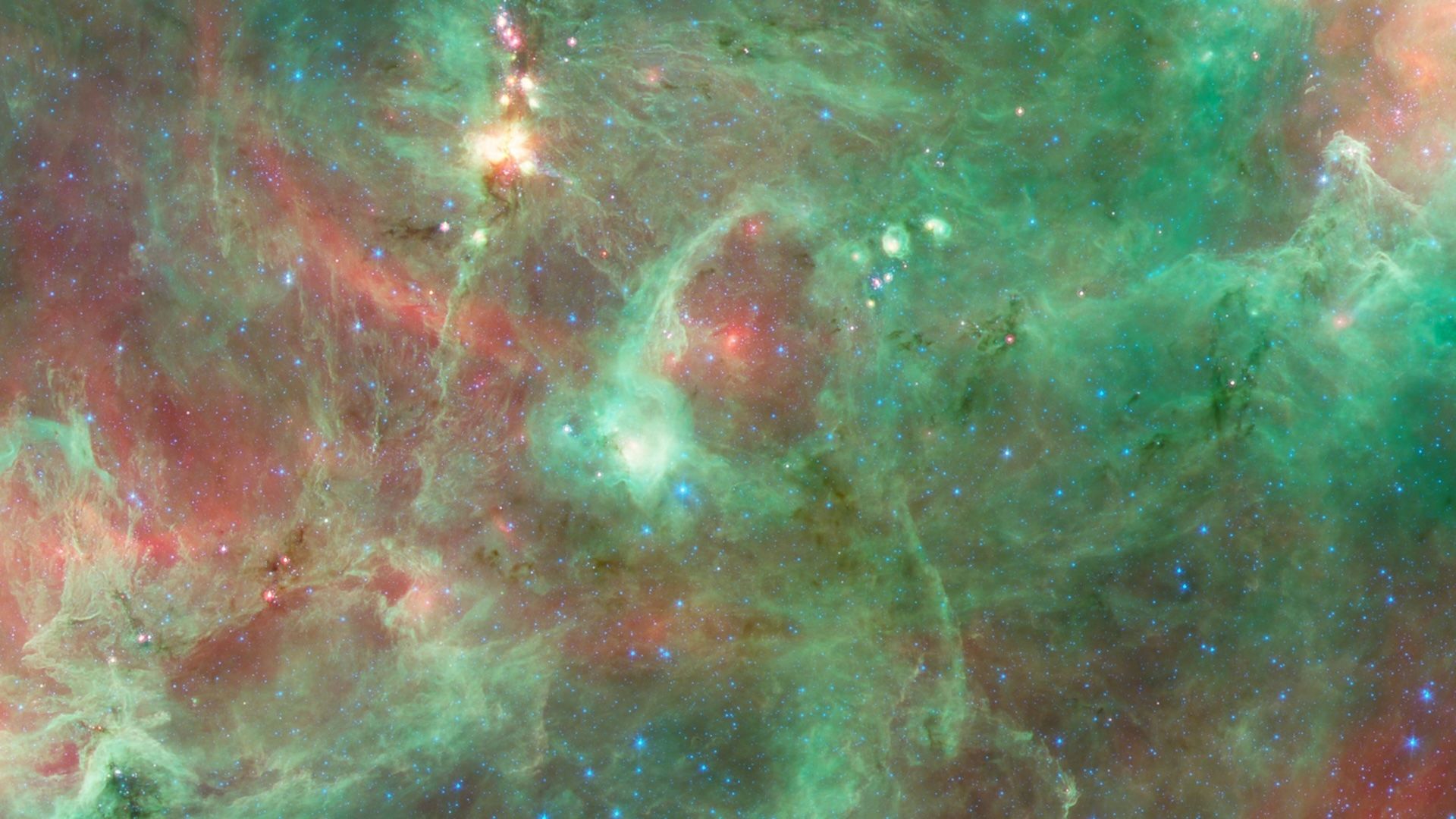
This striking image reveals a glittering cosmic formation dubbed a "diamond ring" — a vast, glowing structure of gas and dust appearing as a circular loop with a bright clump on one side.
About 20 light-years across and located in the Cygnus X star-forming region, the ring is what's left of a bubble of ionized carbon gas, created by the intense radiation and stellar winds of a hot, massive star. But unlike typical spherical bubbles, this one expanded within a flat molecular cloud — a dense cloud of gas and dust where stars are born — before eventually rupturing and losing its symmetry. At just 400,000 years old, it's also exceptionally young — at least relative to the lifespan of massive stars.
Initially, a glowing clump of young stars appears to form the "diamond" in the ring, but researchers found that this grouping is actually a separate object. It lies a few hundred light-years in front of the ring and is merely aligned by chance when viewed from Earth.
The ring demonstrates how stars can affect far larger areas around them.
"The 'diamond ring' is a prime example of how enormous the influence of individual stars can be on entire cloud complexes," Nicola Schneider, co-author of the study published this week (Nov. 17) in the journal Astronomy and Astrophysics, said in a statement. "Such processes are crucial for understanding the formation of stars in our Milky Way."
The image was captured by NASA's flying Stratospheric Observatory for Infrared Astronomy (SOFIA) observatory, a 2.7-meter (106-inch) telescope in a Boeing 747SP aircraft that flew at an altitude of 45,000 feet (13,700 meters) — above 99% of Earth's atmosphere — enabling it to capture the cosmos in infrared wavelengths that are invisible to ground-based observatories. SOFIA first flew in 2010 and was canceled in September 2022 due to budget constraints. However, its vast archive of infrared observations is still being analysed by astronomers, as it was in this latest discovery.
Though unrelated, the term "diamond ring" in astronomy also refers to a dramatic event during a total solar eclipse — when one drop of sunlight shines through the moon's valleys. The cosmic version shares that visual drama, even if the mechanisms are vastly different.
For more sublime space images, check out our Space Photo of the Week archives.