

On April 10, 2024, the Asteroid Terrestrial-impact Last Alert System (ATLAS) detected first light from an explosion of a massive star with roughly 12 to 15 times the sun’s mass. Just 26 hours later, astronomers pointed the Very Large Telescope (VLT) in Chile at the supernova, as this early and brief window provided a rare opportunity to study the initial phase of a star’s death.
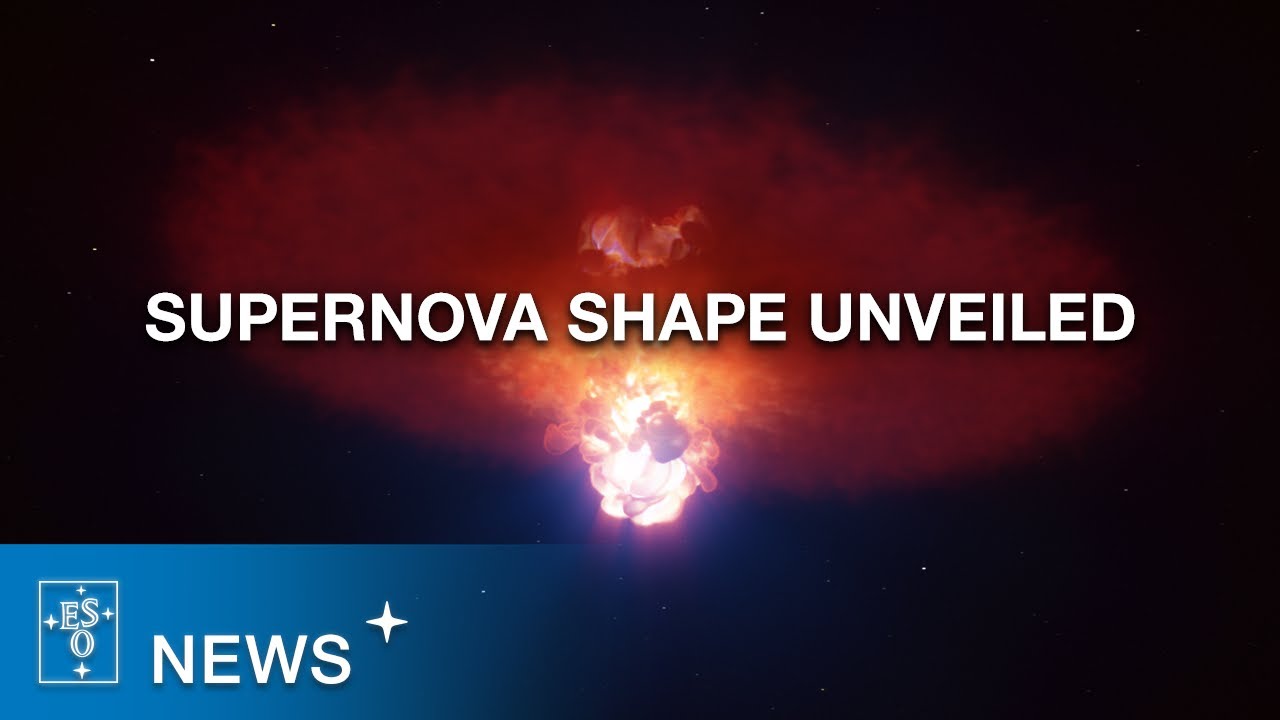
The stunning image is an artist's interpretation, showcasing the supernova explosion as revealed by the VLT data. Thanks to some quick observations, astronomers were able to detect the explosion’s shape during its earliest moments — a phase that would not have been seen if observed just one day later.
Known as SN 2024ggi, this supernova explosion took place in the galaxy NGC 3621, which is located approximately 22 million light-years away in the constellation Hydra. An image captured by the VLT on April 11, 2024 shows the location of this explosion within the galaxy.
A massive star maintains its near-perfect spherical shape due to a delicate balance between the inward pull of its own gravity, and the outward force of the nuclear fusion-powered radiation generated at its center. When this balance is lost, the star dies — gravity finally overpowers the pressure holding its core up, causing it to collapse under its own weight.
This collapse pulls all the outer layers inward. These outer layers then rebound and create a powerful shock wave that rips the star apart. Once the shock breaks through the star’s surface, it releases a lot of energy, increasing the supernova’s brightness dramatically. But how that shock forms and travels outward has long been one of the most debated fundamental questions.
There is a short-lived window, after the explosion has occurred but before it starts to interact with its surroundings, during which astronomers can catch a glimpse of its initial "breakout" shape. Using spectropolarimetry — a technique that sorts light by its wavelengths and reveals the direction in which the light waves vibrate — scientists with the VLT captured this shape for the first time.
Data from the VLT’s FORS2 instrument, the only facility in the Southern Hemisphere that is capable of making such a measurement, showed that the first light from the exploding star wasn’t emitted in all directions equally. Instead, the initial shock was stretched along one axis, like an olive — meaning the explosion wasn’t perfectly spherical.
As the blast expanded, its light began to reveal the supernova’s interaction with the gas surrounding the star. Around day 10, the hydrogen-rich outer layers of the star became visible, and these layers were found to be aligned with the same axis as the first-day shock. This means the core explosion had a stable, directional shape from the very beginning, suggesting an underlying mechanism that drives a consistent orientation.
Study of the unprecedented view has ruled out some of the current supernova models while supporting others, and provides new details about the catastrophic deaths of massive stars.
The study was published Nov. 12 in the journal Science Advances.
For more sublime space images, check out our Space Photo of the Week archives.