
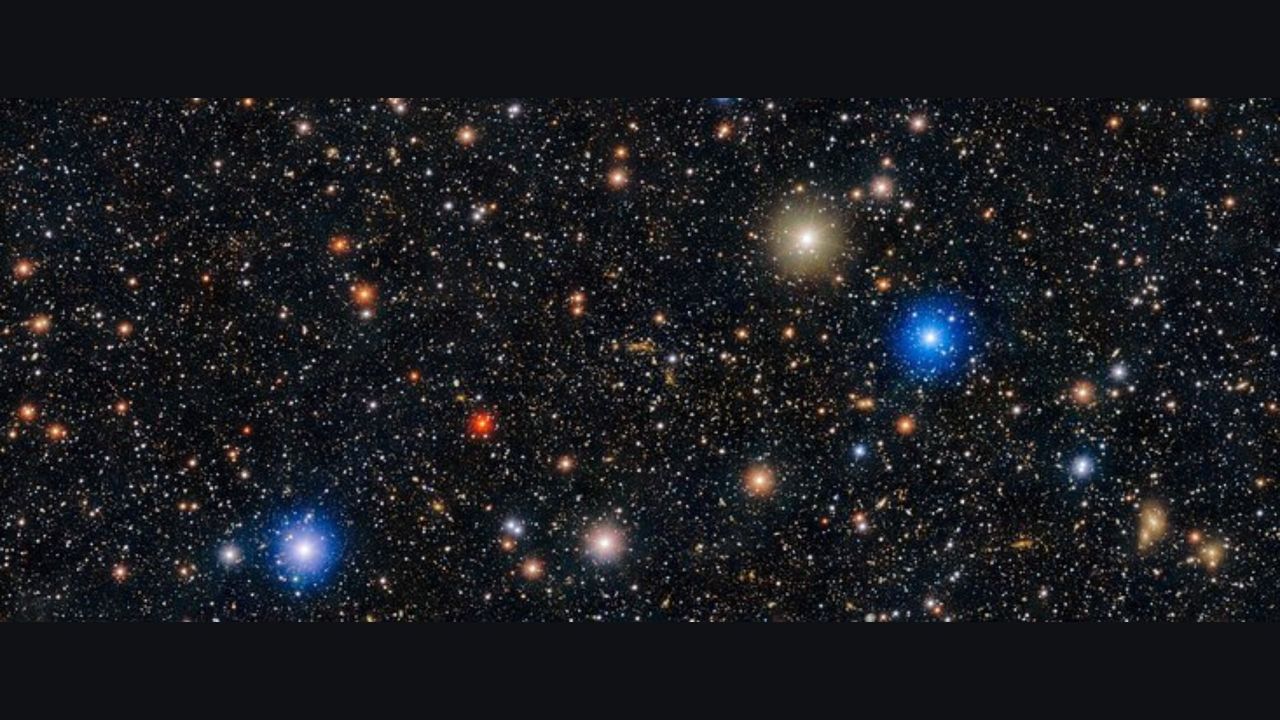
A six-year survey covering 669 million galaxies has revealed insight into dark energy, the mysterious phenomenon driving the universe's accelerating expansion.
The landmark survey paints a complicated picture about our understanding of the universe, showing that two leading theories of cosmology are both equally good fits for the new cosmic expansion observations. However, both theories still fall short in explaining why matter clusters in the universe the way it does, hinting that there’s more work yet to be done.
"These results from the Dark Energy Survey shine new light on our understanding of the Universe and its expansion," Regina Rameika, associate director of the U.S. Department of Energy's Office of High Energy Physics, said in a statement. "They demonstrate how long-term investment in research and combining multiple types of analysis can provide insight into some of the Universe's biggest mysteries."
Expanding our knowledge
Dark energy is thought to make up about 70% of the total energy in the universe, but astronomers still know very little about its true nature. Scientists proposed the concept to explain observations that suggest the universe is expanding at an ever-accelerating rate. The DES is one of several collaborations developed to study the phenomenon in more detail.

In a new paper posted to the preprint server arXiv Jan. 21, DES scientists used four kinds of markers to probe the universe's expansion: baryonic acoustic oscillations, or fluctuations in the density of normal matter throughout the universe; Type Ia supernovas, stellar explosions that can help scientists gauge the distance of cosmic objects; galaxy clusters; and weak gravitational lensing, which occurs when a galaxy cluster warps space-time, distorting the apparent shapes of objects behind it. A series of 18 supporting papers dig into the findings in detail.
Altogether, the data and analysis are consistent with previous studies of dark energy, though the new work places tighter constraints on models of how the universe behaves. The data mostly align with the standard model of cosmology, in which the density of dark energy is constant. The data also fit with a related model in which the dark energy density varies over time, but it didn't align any better than it did with the standard model.
"It is an incredible feeling to see these results based on all the data, and with all four probes that DES had planned," study co-author Yuanyuan Zhang, an astronomer at the National Science Foundation's NOIRLab, which manages the telescope, said in the statement. "This was something I would have only dared to dream about when DES started collecting data, and now the dream has come true."
Despite the relatively good fit between the data and the standard model, some questions remain. The pattern of galaxy clustering still doesn't line up exactly with predictions from the standard model, but it's not different enough to conclude that the standard model is wrong, the team added.
Still, DES researchers will continue testing this and other models of dark energy in conjunction with the Vera C. Rubin Observatory in Chile to further refine our understanding of the mysterious phenomenon.
"Rubin's unprecedented survey of the southern sky will enable new tests of gravity and shed light on dark energy," Chris Davis, NSF program director for NOIRLab, said in the statement.
DES Collaboration, T.M.C. Abbott et al. (2026, January 21). Dark Energy Survey Year 6 Results: Cosmological Constraints from Galaxy Clustering and Weak Lensing. arXiv.org. https://arxiv.org/abs/2601.14559