

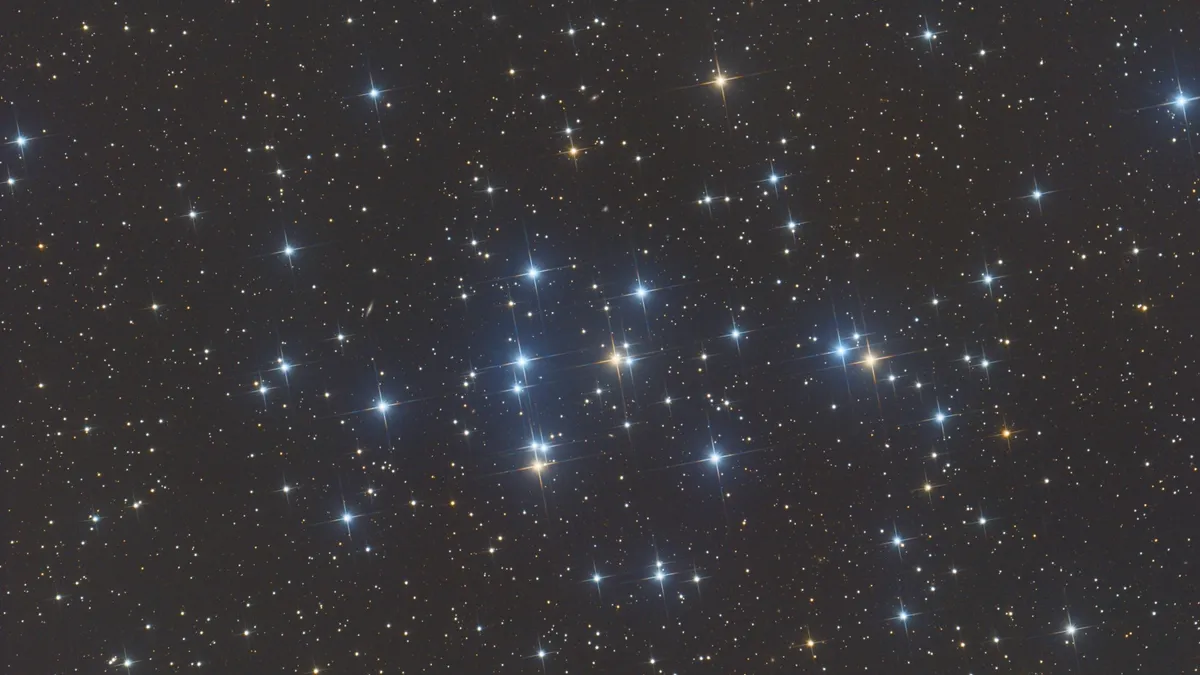
The second full moon of 2026, February's Snow Moon, will rise Sunday (Feb. 1) alongside one of the most beautiful open star clusters in the night sky.
The moon will be officially full at 5:09 p.m. EST on Feb. 1 and will be best seen at dusk at moonrise where you are. It will be in the constellation Leo, hanging below the Beehive Cluster. The moon will also appear bright and full on Feb. 2.
You'll find the Beehive Cluster halfway between the bright stars Pollux in the constellation Gemini (to the top right of the moon) and Regulus in the constellation Leo (to the bottom left of the moon). Regulus will be easiest to see about an hour after the moon rises, as will the other stars of Leo.
If you look up on Feb. 2, it will be possible to watch Regulus be occulted (appear to vanish) by the near-full moon for an hour or so as seen from parts of North America — a rare event that won't be repeated until the late 2030s.
February's full moon is also known as the Hungry Moon, Storm Moon and Candles Moon, according to NASA. Per the Old Farmer's Almanac, other names for February's full moon include the Bald Eagle Moon or Eagle Moon (the Cree), Bear Moon (the Ojibwe), Black Bear Moon (the Tlingit), Raccoon Moon (the Dakota), Groundhog Moon (the Algonquin) and Goose Moon (the Haida).
Next comes the new moon, on Tuesday, Feb. 17, which will cause a rare annular solar eclipse — often called a "ring of fire," as just the center of the sun's visible surface is blocked by the moon — seen only from Antarctica.
The next full moon, the Worm Moon, will rise on March 3. This one will be extra special because it will be a total lunar eclipse. During this spectacular event, colloquially called a "blood moon," the lunar surface will turn a reddish-copper color for 58 minutes as seen from North America, the Pacific, Australia and East Asia.