
Modern drones are efficient and versatile, but Moscow-based startup Neiry believes pigeons are superior because of their greater range, endurance, and ability to access hard-to-reach locations. They don’t require batteries, can fly in different weather conditions, and they are easily replaceable. But how does one control a pigeon as they would a drone?
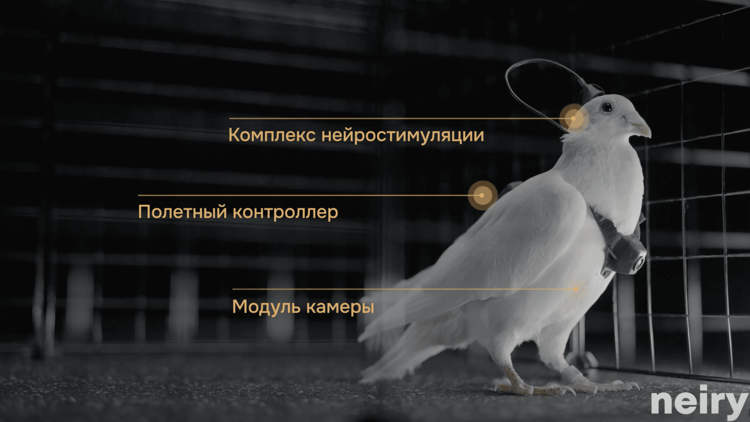
Neiry claims to have developed brain implants that allow its staff to remotely control the birds, effectively turning them into biodrones. Small electrodes are inserted into the bird’s brain through its skull and connected to a stimulator mounted on its head. The birds are also equipped with a solar backpack that houses a controller and other electronics, as well as a chest-mounted camera for surveillance purposes.
In a press release, Neiry explained that the controller receives a pre-loaded flight task similar to those used in aerial drones, while the stimulator sends impulses that make the birds turn left or right, with positioning provided by GPS and other navigation methods.
Neiry claims that its method requires no prior conditioning of the birds, as “any animal becomes radio-controllable after the implantation operation.” The startup’s surgeons use a stereotactic setup to place electrodes accurately in the brain, which should guarantee 100% survivability.
Although it has yet to offer its cyborg pigeons commercially, the Russian company compared the cost of creating a biodrone to that of building an unmanned aerial vehicle, with the added bonus that a pigeon can fly up to 300 miles per day without requiring a battery recharge, and can operate in restricted airspace.
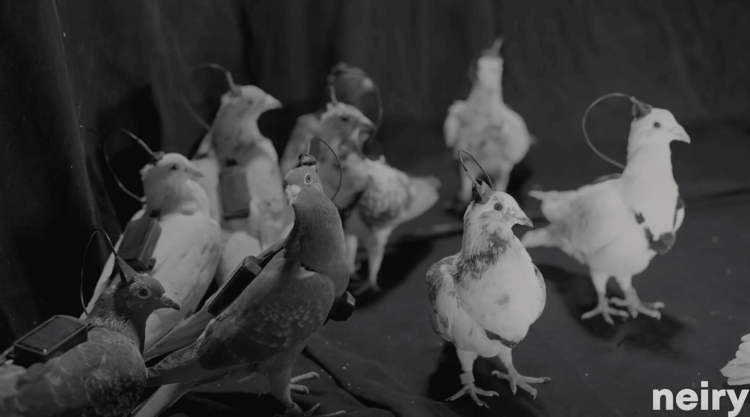
According to Neiry founder Alexander Panov, pigeons are just the start of the company’s PJN-1 project. Virtually any bird can be implanted and controlled remotely.
“Right now, the solution works on pigeons, but any bird can be a carrier,” Panov said. “To carry more payload, we plan to use ravens for monitoring coastal facilities—seagulls, and for large sea areas—albatrosses.”
Neiry claims that the biodrones could be used in a variety of situations, from monitoring infrastructure and inspecting industrial sites to assisting humans in rescue missions. No mention of covert surveillance and military use, but experts fear that, should the drones work as advertised, Putin’s regime would be all over them.
However, we don’t have a lot to go by, right now, and, for all we know, Neiry’s PJN-1 project could be a lot less impressive than it sounds. After all, we’ve seen plenty of Russian tech failures in the past.