The deep interiors of ice giant planets such as Uranus and Neptune may contain a previously unknown form of matter. This possibility comes from new computer simulations conducted by Carnegie scientists Cong Liu and Ronald Cohen.
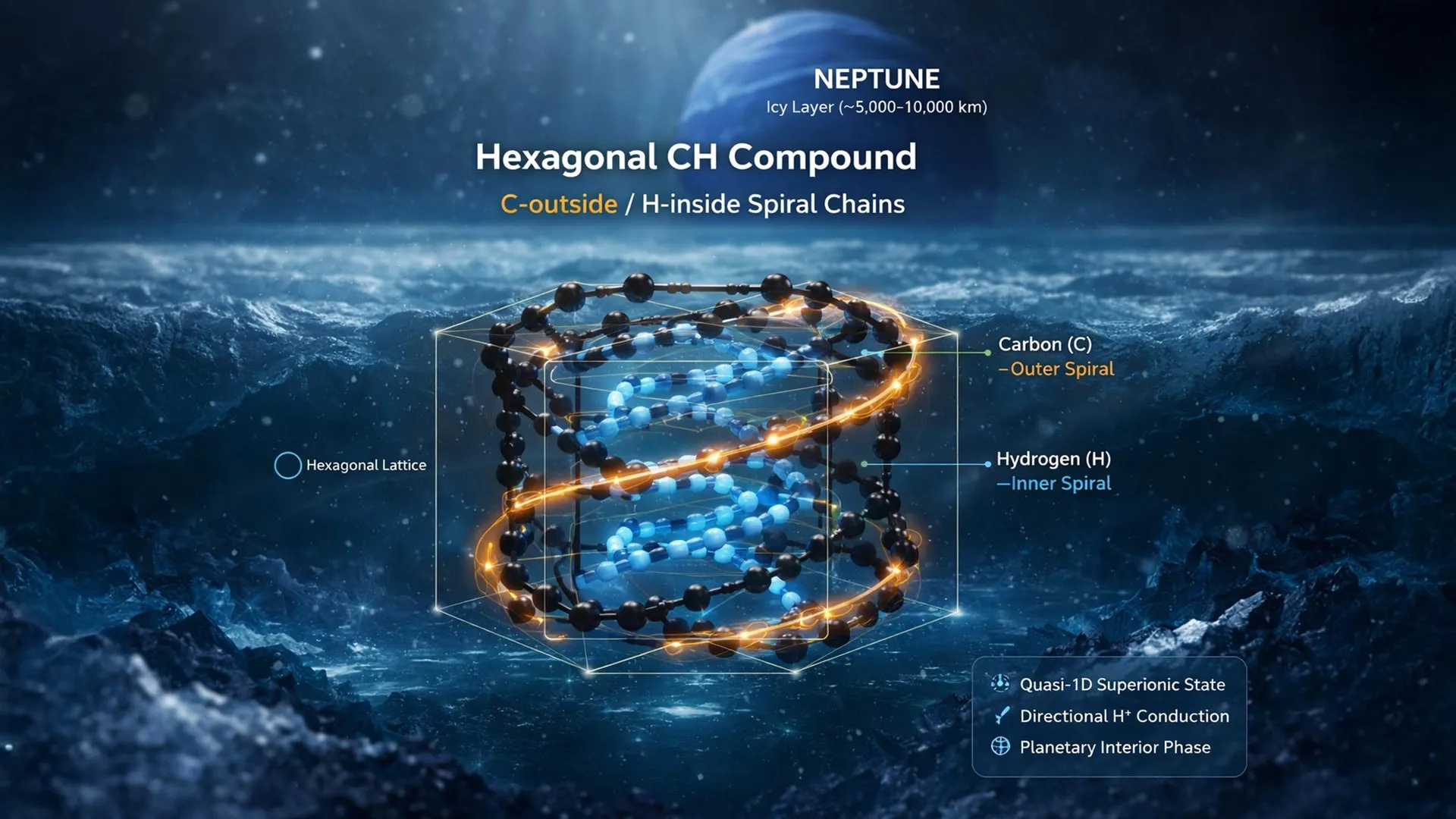
Their study, published in Nature Communications, suggests that carbon hydride could take on an unusual quasi-one-dimensional superionic state under the intense pressures and temperatures found far beneath the surfaces of these distant planets.
Why Planetary Interiors Matter
More than 6,000 exoplanets have been discovered so far, and that number continues to grow. To better understand how planets form and evolve, researchers from astronomy, planetary science, and Earth science are increasingly working together. By combining observations, experiments, and theoretical models, they aim to uncover the physical processes that shape planets, including how magnetic fields are generated.
This growing interest also extends to the hidden layers within planets and moons in our own Solar System. Studying what happens deep below the surface can provide clues about planetary behavior and even help scientists assess whether distant worlds could support life.
"Hot Ice" Layers Inside Ice Giants
Data on the densities of Uranus and Neptune indicate that these planets contain unusual internal layers often described as "hot ices." These regions sit beneath outer atmospheres of hydrogen and helium and above solid cores.
Scientists believe these layers are made up of water (H2O), methane (CH4), and ammonia (NH4). However, the extreme conditions in these environments likely force these familiar compounds into exotic and unfamiliar forms.
Simulating Extreme Planetary Conditions
The intense pressures and temperatures inside ice giants can produce states of matter that do not exist on Earth. To explore this, Liu and Cohen used high-performance computing and machine-learning tools to run detailed quantum simulations of carbon hydride (CH).
They modeled conditions ranging from nearly 5 million to nearly 30 million times Earth's atmospheric pressure (500 to 3,000 gigapascals) and temperatures between 6,740 and 10,340 degrees Fahrenheit (4,000 to 6,000 Kelvin).
A Strange "Spiral" Superionic State
The simulations revealed a striking structure. Carbon atoms form an ordered hexagonal framework, while hydrogen atoms move through it along spiral-like paths. This creates a quasi-one-dimensional superionic state.
Superionic materials are unusual because they behave partly like solids and partly like liquids. One type of atom remains locked in place within a crystal structure, while another type moves freely through it.
"This newly predicted carbon-hydrogen phase is particularly striking because the atomic motion is not fully three-dimensional," Cohen explained. "Instead, hydrogen moves preferentially along well-defined helical pathways embedded within an ordered carbon structure."
Implications for Heat, Electricity, and Magnetic Fields
The directional movement of hydrogen atoms could have major effects on how energy flows inside planets. It may influence how heat and electricity are transported through these deep layers.
These properties are especially important for understanding how Uranus and Neptune generate their magnetic fields, which differ in unusual ways from those of other planets.
Broader Impact Beyond Planetary Science
The findings also highlight how simple elements can behave in surprisingly complex ways under extreme conditions. Even basic compounds like carbon and hydrogen can form highly organized and unexpected structures.
"Carbon and hydrogen are among the most abundant elements in planetary materials, yet their combined behavior at giant-planet conditions remains far from fully understood," Liu concluded.
Beyond helping scientists understand distant planets, this research could also inform advances in materials science and engineering by revealing new types of directional behavior in matter.