
Despite decades of effort, scientists have never recovered dinosaur DNA. Most paleontology research today still focuses on searching for traces of original organic material in fossils, but DNA has not survived the passage of time.
Much of what we understand about dinosaurs comes from fossilized bones and teeth. These durable remains preserve well, but they offer only limited insight into how these animals actually lived.
Soft tissues, on the other hand, can reveal far more. These rare fossilized materials include muscles and ligaments, pigments or even skin (like scales or feathers). They provide important clues about appearance, movement, and behavior.
Another type of soft tissue sometimes preserved inside bones is blood vessels. My research team and I identified preserved blood vessels in a Tyrannosaurus rex fossil, and our findings were recently published in Scientific Reports.
A Discovery That Began With Physics
As an undergraduate physics student at the University of Regina, I joined a research group that used particle accelerators to study fossils. During that time, I used advanced 3D imaging techniques to examine a T. rex bone and noticed structures that appeared to be blood vessels.
Nearly six years later, I am now pursuing a PhD, continuing to apply physics-based methods to improve how fossils are analyzed.
The Largest T. Rex Ever Found
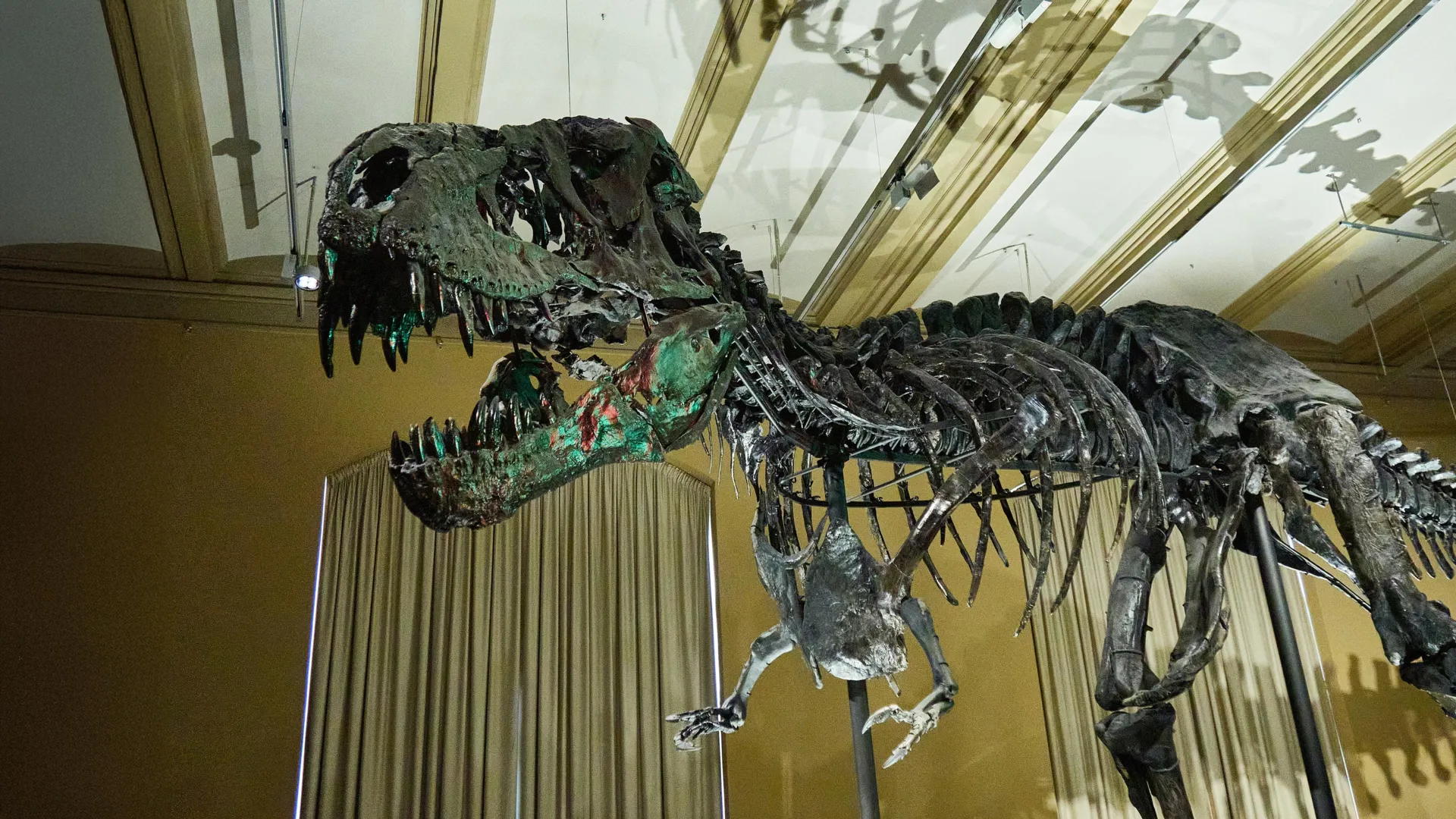
The preserved vessels came from an extraordinary specimen known as Scotty. Housed at the Royal Saskatchewan Museum in Canada, Scotty is the largest T. rex ever discovered and one of the most complete.
Evidence suggests Scotty lived a difficult life around 66 million years ago. Many of its bones show signs of injury, possibly from combat with another dinosaur or from disease. One rib stands out, showing a large fracture that had only partially healed.
When bones are damaged, the body increases blood vessel activity in the affected area to support healing. The structures we observed in Scotty's rib appear to be part of that process, forming a dense network of mineralized vessels that we reconstructed using 3D models.
Advanced Imaging Reveals Hidden Structures
Studying the inside of fossil bones presents two major challenges. First, researchers need to look inside without damaging the specimen. Second, fossilized bones are extremely dense because minerals have replaced the original organic material over millions of years.
We initially considered using an computed topography (CT) scan, similar to those used in medicine. While this method is non-destructive, standard CT scanners cannot penetrate the dense structure of large fossils.
Instead, we turned to synchrotron light, a powerful form of high-intensity x-rays produced at specialized particle accelerator facilities. This technique allowed us to visualize tiny internal features such as blood vessels with remarkable clarity.
Synchrotron imaging also made it possible to analyze the chemical composition of the structures. The vessels had been preserved as iron-rich mineralized casts, which is a common fossilization process. Interestingly, they appeared in two distinct layers, reflecting a complex environmental history that contributed to their preservation.
What Blood Vessels Reveal About Dinosaur Life
The partially healed fracture in Scotty's rib offers a rare opportunity to study how a T. rex recovered from injury. By examining the preserved blood vessels, researchers can gain insight into healing processes and survival strategies in large predatory dinosaurs.
This work may also provide a basis for comparison with other dinosaur species and with modern animals such as birds, which are closely related to dinosaurs.
The findings could guide future fossil discoveries as well. Bones that show signs of injury or disease may be more likely to preserve blood vessels or other soft tissues, helping scientists target promising specimens.
With the combination of physics, paleontology, and advanced imaging technologies, researchers are beginning to uncover details about dinosaur biology that were once thought impossible to study.