
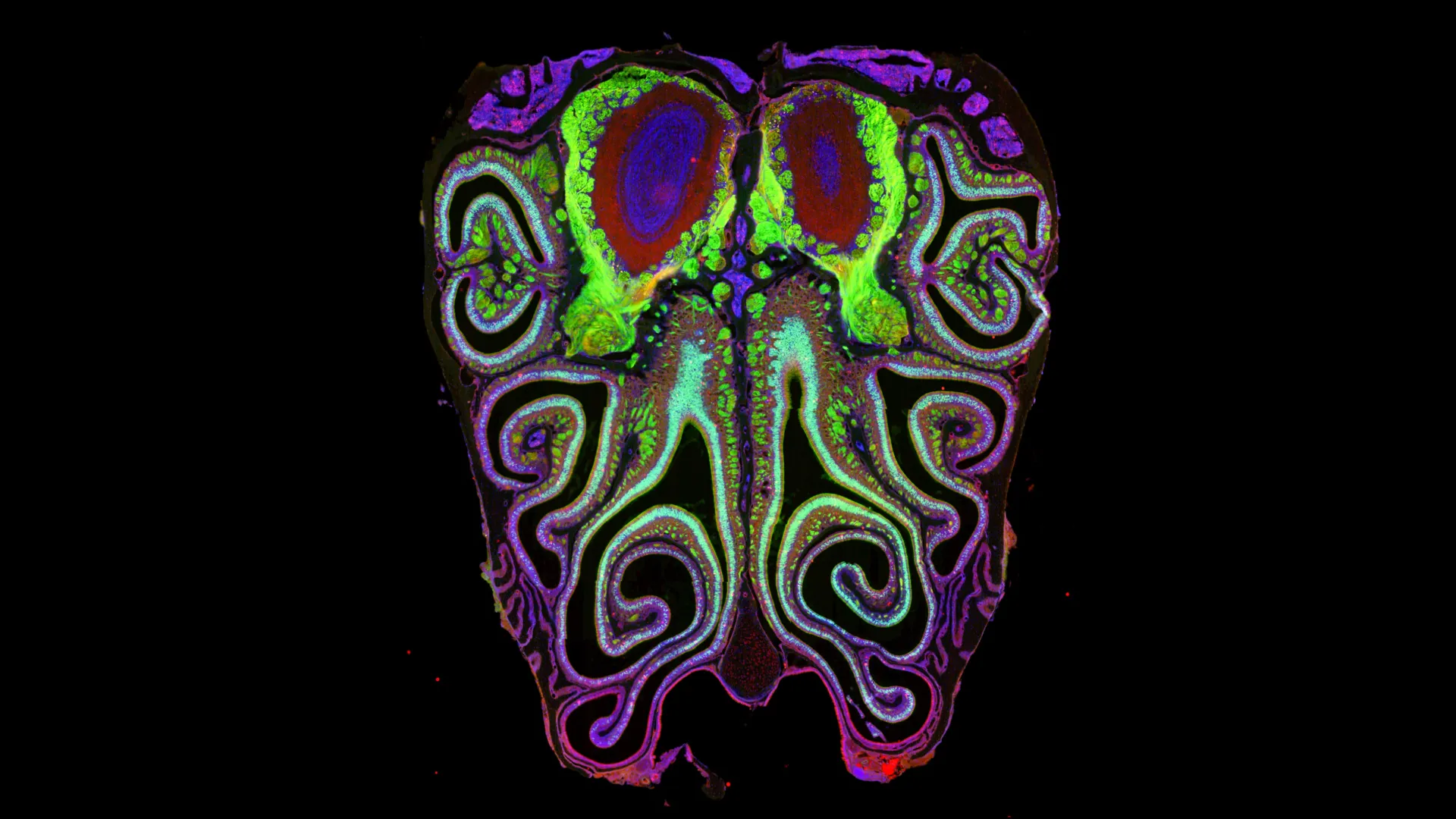
Smell shapes how we experience the world every day. It helps us detect hazards, adds depth to flavor, and connects strongly to memory and emotion. Despite its importance, scientists have struggled to fully understand how this sense works at a biological level.
"Olfaction is super-mysterious," said Sandeep (Robert) Datta, professor of neurobiology in the Blavatnik Institute at Harvard Medical School. Compared with vision, hearing, and touch, the basic biology of smell has remained less understood.
Scientists Create First Detailed Map of Smell Receptors
In a new study using mice, Datta and his colleagues built the first detailed map showing how more than a thousand types of smell receptors are arranged inside the nose.
What they found challenges long-standing assumptions. Instead of being randomly distributed, the neurons that carry these receptors are highly organized. They form horizontal bands, or stripes, running from the top of the nose to the bottom, grouped by receptor type.
"Our results bring order to a system that was previously thought to lack order, which changes conceptually how we think this works," said Datta, senior author of the study.
The researchers also showed that this map in the nose aligns with corresponding maps in the olfactory bulb of the brain. This connection offers new insight into how scent information travels from the nose into neural circuits.
The findings published April 28 in Cell.
The Long Search for a Smell Map
Scientists have long understood how sensory receptors are arranged in the eyes, ears, and skin, and how those patterns connect to the brain. Smell has been the exception.
"Olfaction has been the one exception; it's the sense that has been missing a map for the longest time," Datta said.
One reason is complexity. Mice have about 20 million olfactory neurons, each expressing one of more than a thousand receptor types. By contrast, human color vision relies on just three main receptor types. Each smell receptor detects a specific set of odor molecules, making the system far more intricate.
Researchers began identifying smell receptors in 1991. Over the following decades, they searched for patterns in how these receptors were arranged. Earlier studies suggested that receptors appeared in only a few broad zones, leading to the idea that their placement was mostly random.
As new genetic tools became available, Datta's team revisited the question with more powerful methods.
A Hidden Pattern Revealed in Millions of Neurons
The team analyzed about 5.5 million neurons across more than 300 mice. They combined single-cell sequencing, which identifies which receptors each neuron expresses, with spatial transcriptomics, which pinpoints where those neurons are located.
"This is now arguably the most sequenced neural tissue ever, but we needed that scale of data in order to understand the system," Datta said.
Their results revealed a clear and consistent pattern. Neurons form tightly organized, overlapping horizontal stripes based on the receptor they carry. This arrangement was nearly identical across all the animals studied and closely matched how smell information is mapped in the brain.
How the Smell Map Forms
The researchers also investigated how this precise structure develops. They identified retinoic acid, a molecule that regulates gene activity, as a key factor.
A gradient of retinoic acid in the nose appears to guide neurons, helping each one activate the correct smell receptor depending on its position. When the researchers altered levels of this molecule, the entire receptor map shifted upward or downward.
"We show that development can achieve this feat of organizing a thousand different smell receptors into an incredibly precise map that's consistent across animals," Datta said.
A separate study led by the lab of Catherine Dulac, the Xander University Professor in the Department of Molecular and Cellular Biology at Harvard University, that published in the same issue of Cell had consistent findings.
What This Means for Treating Loss of Smell
Beyond advancing basic science, this discovery could have practical impact. Loss of smell currently has few effective treatments, even though it can affect safety, nutrition, and mental health.
"We cannot fix smell without understanding how it works on a basic level," Datta said.
The team is now working to understand why the receptor stripes appear in their specific order and whether the same organization exists in humans. This knowledge could guide new approaches, including stem cell therapies or brain-computer interfaces, aimed at restoring the sense of smell.
"Smell has a really profound and pervasive effect on human health, so restoring it is not just for pleasure and safety but also for psychological well-being," Datta said. "Without understanding this map, we're doomed to fail in developing new treatments."
Authorship, Funding, Disclosures
Additional authors on the paper include David Brann, Tatsuya Tsukahara, Cyrus Tau, Dennis Kalloor, Rylin Lubash, Lakshanyaa Kannan, Nell Klimpert, Mihaly Kollo, Martin Escamilla-Del-Arenal, Bogdan Bintu, Andreas Schaefer, Alexander Fleischmann, and Thomas Bozza.
Funding for the research was provided by the National Institutes of Health (grants R01DC021669, R01DC021422, R01DC021965, and F31DC019017), the Yang Tan Collective at Harvard, and a National Science Foundation Graduate Research Fellowship.