
A biomaterial designed to travel through the bloodstream could offer a less invasive way to calm inflammation and help injured tissue repair itself. In animal studies, the injectable material improved tissue damage caused by heart attacks in both rodents and large animals. Early proof of concept experiments also suggested that the same approach may one day be useful for other inflammation driven conditions, including traumatic brain injury and pulmonary arterial hypertension.
"This biomaterial allows for treating damaged tissue from the inside out," said Karen Christman, a professor of bioengineering at the University of California San Diego, and the lead researcher on the team that developed the material. "It's a new approach to regenerative engineering."
The findings were reported in Nature Biomedical Engineering in 2022 by a team of bioengineers and physicians. At the time, Christman said a human study testing the safety and effectiveness of the biomaterial could begin within one to two years.
A New Route for Repairing Heart Damage
Heart attacks remain one of the most serious medical emergencies in the United States, with an estimated 785,000 new cases each year. When blood flow to the heart is blocked, cardiac tissue can be injured or die. The body responds by forming scar tissue, but that scar does not contract like healthy heart muscle. Over time, this can weaken the heart and contribute to congestive heart failure.
There is currently no established therapy that directly repairs heart tissue after a heart attack. Existing care focuses on restoring blood flow, limiting further injury, and managing the risk of future heart problems.
"Coronary artery disease, acute myocardial infarction, and congestive heart failure continue to be the most burdensome public health problems affecting our society today," said Dr. Ryan R. Reeves, a physician in the UC San Diego Division of Cardiovascular Medicine. "As an interventional cardiologist, who treats patients with coronary artery disease and congestive heart failure on a daily basis, I would love to have another therapy to improve patient outcomes and reduce debilitating symptoms."
From Heart Hydrogel to Bloodstream Infusion
The work builds on earlier research from Christman's team involving a hydrogel made from the natural scaffolding of cardiac muscle tissue, also known as the extracellular matrix (ECM). That gel was designed to be delivered directly into damaged heart muscle through a catheter. Once in place, it forms a supportive structure that encourages cell growth and tissue repair.
Results from a successful phase 1 human clinical trial of that earlier hydrogel approach were reported in fall 2019. The trial found that transendocardial injection of VentriGel, a cardiac extracellular matrix hydrogel, was safe and feasible in post heart attack patients with left ventricular dysfunction, although larger randomized studies would be needed to test whether it improves outcomes.
The direct injection method, however, has an important limitation. Because it requires a needle based injection into the heart muscle, it generally cannot be used immediately after a heart attack. Delivering it too soon could risk additional injury.
That challenge pushed the researchers toward a different idea: a biomaterial that could be infused into a blood vessel in the heart during procedures such as angioplasty or stenting, or delivered through an IV.
"We sought to design a biomaterial therapy that could be delivered to difficult-to-access organs and tissues, and we came up with the method to take advantage of the bloodstream -- the vessels that already supply blood to these organs and tissues," said Martin Spang, the paper's first author, who earned his Ph.D. in Christman's group in the Shu Chien-Gene Lay Department of Bioengineering.
Why IV Delivery Matters
The bloodstream based approach gives the biomaterial a major practical advantage. Instead of staying in a few injection sites, it can spread more evenly through damaged tissue. That could make it especially valuable after a heart attack, when injured areas may be difficult to reach directly and time is critical.
The Nature Biomedical Engineering study described the material as an intravascularly infused extracellular matrix biomaterial made from decellularized, enzymatically digested, and fractionated ventricular myocardium. The material was designed to localize to injured tissue by binding to leaky microvasculature and was largely degraded within about three days.
How the Biomaterial Is Made
To create the injectable version, researchers in Christman's lab began with the hydrogel they had already developed and tested for compatibility with blood injections. The problem was particle size. The original hydrogel contained particles that were too large to effectively target damaged, leaky blood vessels.
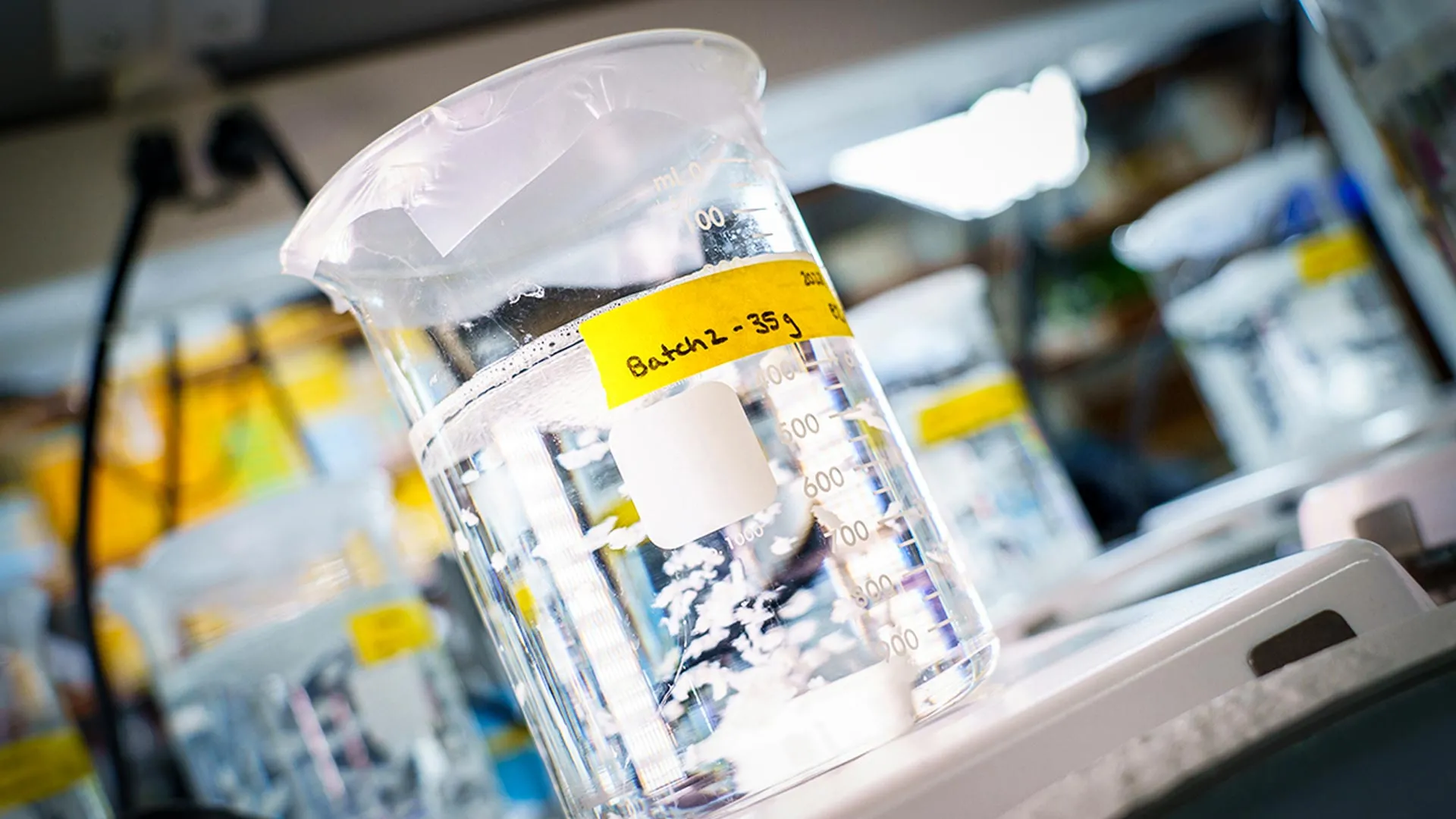
Spang solved this by processing the liquid precursor of the hydrogel in a centrifuge. This allowed the team to separate out larger particles and keep only nano sized particles. The material was then dialyzed, sterile filtered, and freeze dried. When sterile water is added to the final powder, it becomes a biomaterial that can be delivered intravenously or infused into a coronary artery in the heart.
How It Finds Injured Tissue
When the researchers tested the biomaterial in a rodent model of heart attack, they expected it to move through leaky blood vessels and into damaged tissue. After a heart attack, gaps can form between endothelial cells, which line the inside of blood vessels.
Instead, the team saw something more surprising. The biomaterial attached to those endothelial cells, helped close the gaps, and appeared to speed up blood vessel healing. That process reduced inflammation, one of the major drivers of tissue damage after injury.
The researchers then tested the treatment in a porcine model of heart attack and saw similar results. In rats and pigs with induced acute myocardial infarction followed by intracoronary infusion, the biomaterial was linked with reduced left ventricular volumes, improved wall motion scores, and gene expression changes associated with tissue repair and inflammation.
Potential Beyond the Heart
Although most of the work centered on heart attack damage, the researchers also tested whether the same biomaterial could target other inflamed tissues. In rat models, they found proof of concept that the approach could be useful for traumatic brain injury and pulmonary arterial hypertension.
That broader potential is one of the most intriguing parts of the work. Many organs and tissues are difficult to access directly, but all are supplied by blood vessels. If a biomaterial can use those vessels as a delivery route, regenerative medicine may be able to reach injuries that are otherwise hard to treat.
"While the majority of work in this study involved the heart, the possibilities of treating other difficult-to-access organs and tissues can open up the field of biomaterials/tissue engineering into treating new diseases," Spang said.
What Has Happened Since the 2022 Study
Since the original study, related work has continued to explore how extracellular matrix based biomaterials influence repair after myocardial infarction. A 2025 Nature Communications study from researchers including Christman used spatial transcriptomics and single nucleus RNA sequencing to examine how injectable extracellular matrix biomaterials affect heart tissue after myocardial infarction. The study found pro repair signals involving immune modulation, blood vessel and lymphatic development, fibroblast activation, myocardial salvage, smooth muscle cell proliferation, and neurogenesis in rat models.
That later work did not replace the need for clinical testing of the intravascular biomaterial, but it added more detail about how this class of cardiac extracellular matrix therapies may influence healing at the cellular and regional level inside injured hearts.
Ventrix Bio, Inc., the startup cofounded by Christman, has also continued advancing related cardiac extracellular matrix technology. A ClinicalTrials.gov listing for VentriGel describes a phase 1 open label study in children with hypoplastic left heart syndrome, sponsored by Emory University, to assess safety and feasibility of intramyocardial injection of the Ventrix Bio extracellular matrix material. The listing was not yet recruiting when accessed.
Next Steps for Human Testing
Christman and Ventrix Bio have planned to seek FDA authorization to study the newer intravascular biomaterial for heart conditions in humans. If cleared for clinical testing, the therapy would need to show that it is safe, practical to deliver, and effective enough to improve patient outcomes.
For now, the treatment remains experimental. But its appeal is clear: rather than requiring direct injections into heart muscle, it could potentially be delivered through existing blood vessel based procedures or by IV, reaching injured tissue from within.
"One major reason we treat severe coronary artery disease and myocardial infarction is to prevent left ventricular dysfunction and progression to congestive heart failure," said Dr. Reeves. "This easy-to-administer therapy has the potential to play a significant role in our treatment approach."