SOUTHAMPTON, NEW YORK — Shinnecock Hills has been described as one of the best golf courses in all the land. It has been touted as the perfect championship test where good shots are rewarded and poor shots are punished. It has the reputation as being as difficult as they come.
Even though a two-hour fog delay early Thursday morning combined with a less than perfect forecast flipped the expected wave advantage -- the afternoon played more than one stroke easier than the morning -- sound decision-making, strategy and execution were still required to move up the leaderboard at the 2026 U.S. Open.
Knowing this, the perfect championship spot to watch this unfold was among a cluster of holes spanning Nos. 9-12. Although some exercise was required to take in these golf shots, what was received was the difference between this venue and those seen on a weekly basis.
It started with a march out to the par-4 10th and the fork in the road players were immediately met with if they started their rounds on the back nine. Send one down the hill and have a wedge back up the hill or lay back, have a clear view of the green with 180 yards between you and the hole.
The first player on the golf course, Harry Higgs, chose the former.
And he chose wrong.
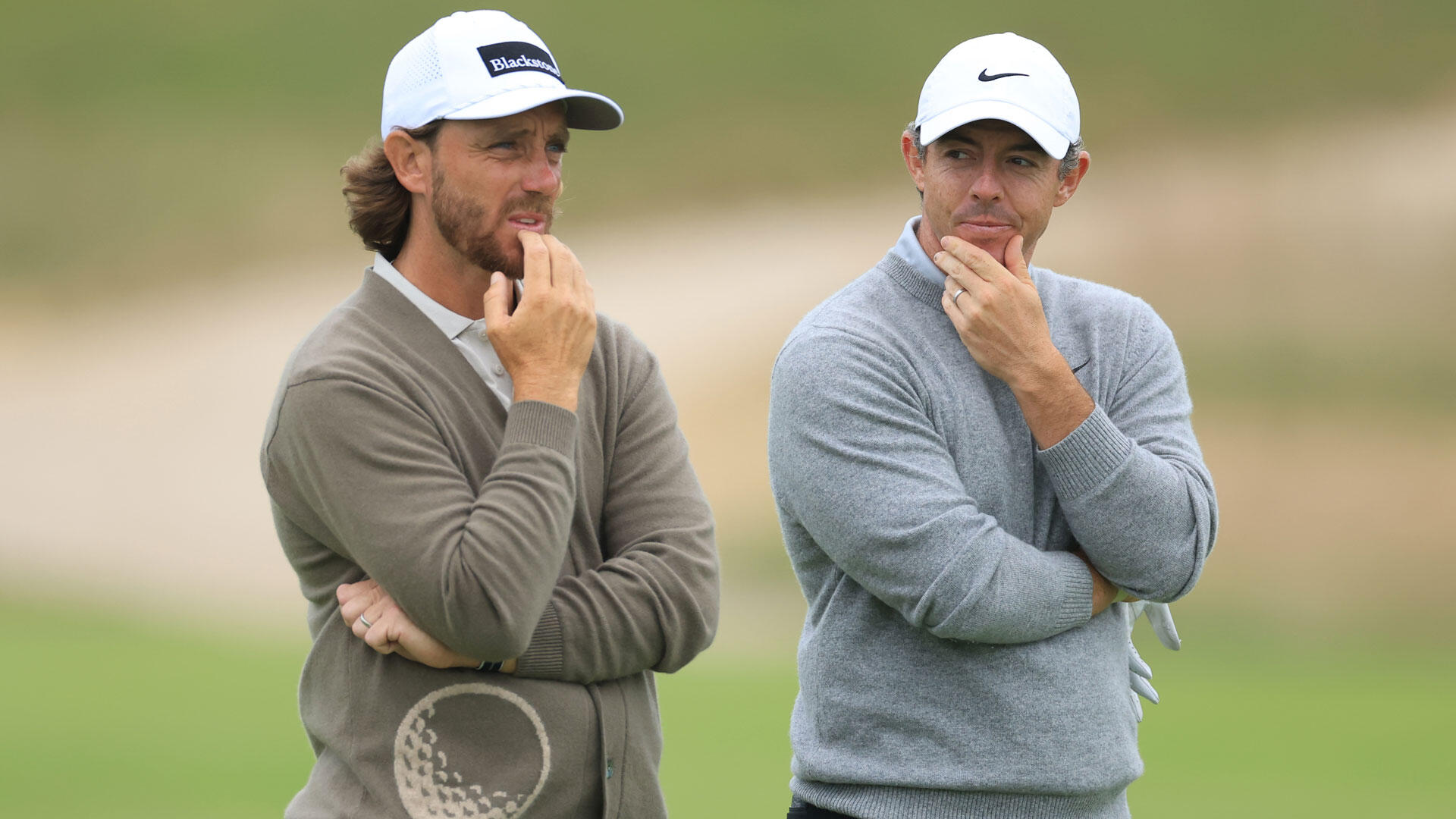
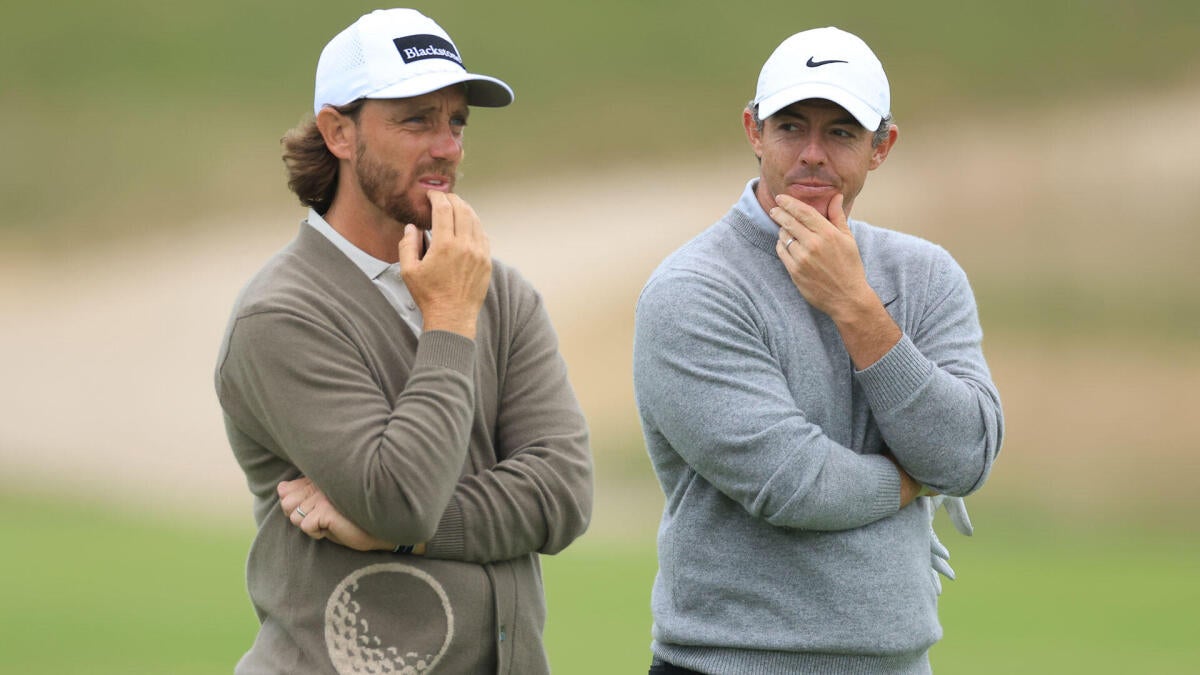
These decisions were made on every tee, whether noticed or not, and through to the completion of the hole. Rory McIlroy chose to lay back more often than not on Thursday. Ludvig Åberg believed the opposite was beneficial to his game. Both of them shot 1-under 69. Tommy Fleetwood played the middle en route to his 70. The trio played three different games and combined to shoot the lowest round in the morning wave.
There's more than one way to get around Shinnecock Hills, but to see first hand and then dive into the data to confirm (or disprove) theories, prior conversations with players or what the data tells players to do (and them going against it) was an exercise worth, well, the exercise.
So without further ado, here are the musings from Shinnecock Hills on Thursday and the notable decision points, holes and statistics to keep in mind as the 2026 U.S. Open continues.
An opening handshake?
I was curious to see if anyone would take the head cover off, and it did not take long as Chris Gotterup took driver off the tee to kick off his U.S. Open. The four-time PGA Tour winner found the left greenside bunker and was unable to get up-and-down for his birdie, but it sparked the idea that few others believed viable.
With wind coming off the left and the first hole curving that same direction, Gotterup's left-to-right shot shape with the wind assisting made a perfect match. Yet only a total of seven players chose to take on that fairway bunker on the right side that requires a carry in the 285 yards range.
Of those seven, three made birdies and four made pars with Jordan Spieth being the one to not give himself a realistic birdie look.
The hole played slightly over par and in the middle of the road in terms of difficulty relative to the rest of the golf course -- 12th overall. Moving forward, if players were to push the envelope and try to scratch out another scoring chance, it could come on the opener depending, of course, on the wind direction and pin location.
Tale of two par 5s
It's one of the beauties of Shinnecock Hills and the routing instilled by William Flynn many moons ago. No matter the wind direction, the par-5 5th and the par-5 16th will play completely different. Monday's practice round wind was an anomaly as a player I talked to early in the week told me he hit driver, 3 wood over the green. On Wednesday (in a wind similar to today's), he hit driver, 3 wood, 8 iron that barely caught the front of the surface.
On Thursday, players held on for dear life on No. 16 as it ranked as the fourth-most difficult hole and yielded just nine birdies. As one of Shinnecock's regular caddies told me, "It feels like it's playing 900 yards."
For as long as No. 16 played, No. 5 played that short. McIlroy needed just a driver and a pitching wedge to throw a timely eagle on his scorecard.
"Driver, pitching wedge, putt," McIlroy said. "I think I had 194 to the pin. It was like 10 to cover the false front. I think I had like 169. I was trying to pitch the ball like 180, and I ended up pitching the ball like 190. I carried that pitching wedge 190 yards. It just shows how strong the wind is out there.
"It's nice to have a wedge in your hand with second shots at par 5, and with the greens still being receptive, I could get the ball to stop on that green. It was nice to hole the putt."
Still, though, the tight rope act of pouncing on a scoring opportunity and not giving away strokes is a delicate one. Just look at Billy Horschel, who sent his second long of the green which runs off well below the surface and makes for a difficult pitch. Horschel must have felt like he was in position to make a four, but walked off the green with a snowman instead.
The toughest par 3
It was not the long par-3 2nd that read 252 yards on the scorecard, nor was it the devilish uphill par-3 11th. Instead, it was The Redan hole, the par-3 7th where players simply could not find the surface off the tee. In fact, the field found the green in regulation less than 30% of the time -- far and away the lowest mark of any hole on the day.
"I hit like a 6-iron. You almost don't realize how good of a shot. Like even me, I hit a 6-iron, that's 20 feet, 25 feet. Even to just be on the green, I look back, and I feel like it's an unbelievable shot. If somebody else hits it, I'll be like, 'great shot,'" Fleetwood said after his round.
"Yeah, it's a very, very tiny spot, and… when the wind is working, the way that the green is sloping as well, you obviously know that left bunker and left is OK. Like, you can't get up-and-down, but then that's like the mental game in it as well. How disciplined can you be? How aggressive can you try to hit the perfect shot?"
Look at this scatterplot below with the black marks representing bogeys or worse made. Players erred on missing to the left as it gave them an uphill chip back into the wind, while anything to the right was rightfully dead (unless you're Max Greyserman who is that red birdie dot in the bunker).
Two variables working together
An underrated aspect of the wind direction is what it does when in conjunction with where balls settle in the fairway. On No. 9, for example, those up the right side of the fairway found their ball above their feet for their uphill approaches. Without the luxury of possibly flighting their shots, players were tasked with either playing up against the wind with a ball above their feet or riding a right-to-left wind with a stance conducive for that shot shape.
It got McIlroy as he finished his round with two straight bogeys, but someone like Corey Conners -- who is known to sling it from right to left -- aimed way right of the green, used the slope, the wind and the contours of the green to his advantage. Compounding variables working together.
Strategy behind No. 10
If I had my way I would have stayed by this green the entire day. Players from both on top of the hill and down below were flummoxed as a large number of third shots were played down below (for the second time) or beyond the green.
During the practice days, players were spending 5 to 10 minutes beyond the putting surface trying to figure out the bounce into the slope and the speed in which to play their chips given the soft greens and awkward relationship between the green speed and the rest of the golf course.
Of the 10 birdies made on No. 10, three came from on top, six came from down the hill and Andrew Novak somehow made a three from the right rough (his strategy was not confirmed).
"I'd definitely go for it. I don't see it as a layup, no. I just do not see it as a layup," Padraig Harrington said. "I'm very comfortable down there hitting that shot. I know it's not the easiest shot from down there, but I think it's easier than the 180-yard shot from the top of the hill. If you tell me more birdies have been made, maybe that's the game."