
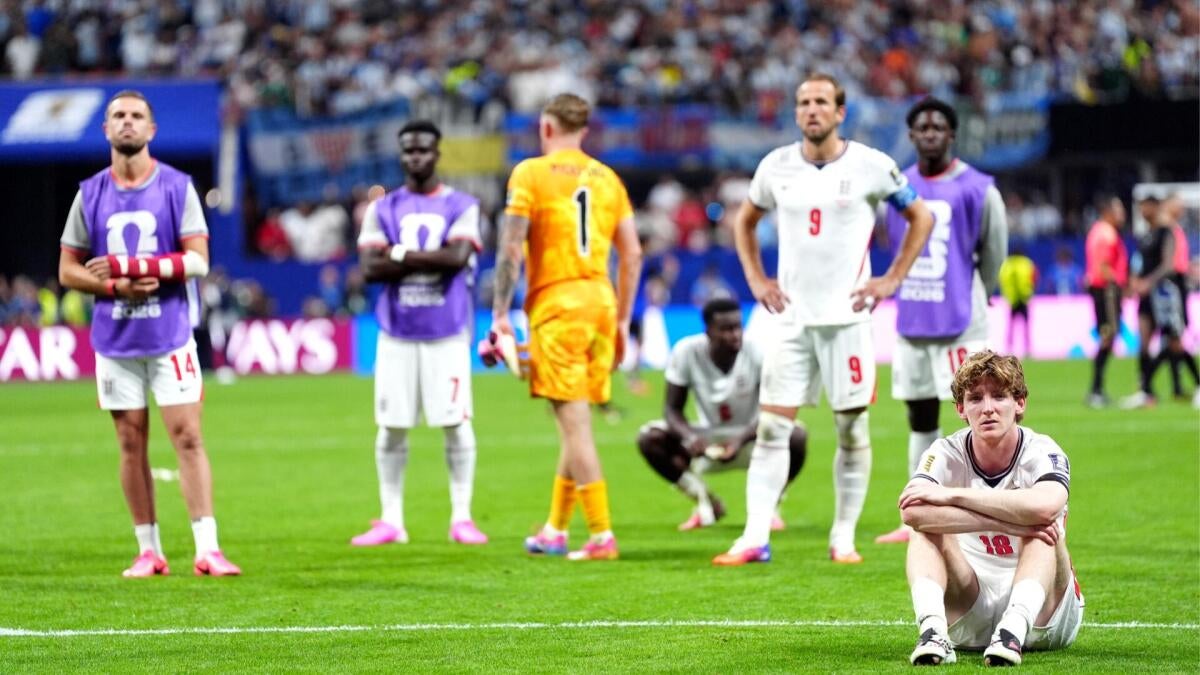
ATLANTA – Anthony Gordon's 55th-minute strike was monumental in its own right, since there is simply no replacing the game-opening goal in a World Cup semifinal. As Djed Spence and Jordan Pickford pitched in with major defensive contributions in the follow-up, though, it felt like England were rising to the occasion.
Gordon's goal was merely the foundation for England to perform in a game state that did not suit them – or anyone, for that matter. Argentina had gone full cynic from the opening whistle, a new genre of a cagey game on full display at Mercedes-Benz Stadium. It was the perfect set-up for any opponent to spiral, several doing so as Argentina reached the World Cup semifinals the hard way, surviving despite being on the repose against Cape Verde, Egypt and Switzerland. And yet…
"It felt like it was a matter of time," England's Dan Burn said post-match.
Enzo Fernandez's long-range shot flew into the back of the net, even if it was unlikely for a hit from that range to do so. Three minutes into stoppage time, Lionel Messi's excellent cross found Lautaro Martinez's head and he quickly finished from close range. The reigning champions had reversed a 1-0 deficit in a matter of minutes – and punched their ticket to a second straight World Cup final along the way.
Argentina have earned the right to be called the World Cup villains. They have never seemed like a championship-quality team, tactical organization and cohesion never their strong suit. They were on the brink of disaster against each of Cape Verde, Egypt and Switzerland before nearly being knocked out by England. They rode their luck further than any team should en route to the final, nine of their 11 knockout round goals coming after the 78th minute. They have benefitted from controversial refereeing decisions, the end of their golden era easy to spot with the naked eye. It is understandable, to some degree, that England would slip into a false sense of security as they inched closer to the final whistle on Wednesday because they had played like the better team for much of the second half. Doing so against the comeback kings, though, was foolish and they wound up paying the price.
If Gordon's goal was a building block for what seemed to be a historic outing for England, it was also fuel for Argentina's fire. The reigning champions had five shots to England's two but had mustered just 0.17 expected goals when Gordon's strike flew into the back of the net. For their efforts reducing the affair to a battle rather than a game, they had the rewards to show for it. Things flipped on a dime from there, though – they attacked in wave after wave because they no longer had a choice. There is no substitute for a goal, especially with a spot in the World Cup final on the line. They fired 10 shots at the Three Lions' goal before the final whistle blew, some more meaningful than others. Perhaps the reason why England were feeling comfortable is because it worked for a while. They may have had just 16.8% possession from the 55th to the 72nd minute and 0.04 expected goals from two shots, but Argentina only clocked in at just 0.15 xG for their efforts.
"I feel like we struggled to keep the momentum of the game," England captain Harry Kane said. "We'd done so well for 60 minutes, we scored, we deserved to be ahead and then for one reason or another, we struggled to keep the ball. We struggled to put pressure on the ball and it just allowed them to create more momentum. It created more attacks for them in our final third and it's a normal mindset to try and hang on and hold on to the one goal lead but still with 20 minutes with stoppage time to go, it was always going to be a lot of time."
Then came Tuchel's clinical error. A solid defensive showing was already in progress but the England coach took off Gordon to bring on another center back in Ezri Konsa, the formation switching to a back five. After Lionel Scaloni's side delivered one version of cynicism, Tuchel whipped out his own unique definition – instead of using talented attackers like Harry Kane and Jude Bellingham to scope out a chance or two while Argentina pushed forward, England sat back even further. The attacking wave only became more mighty for Argentina from there. While England took just a single shot and mustered just 0.05 xG after Konsa came on in the 72nd minute, Argentina were finally finding their rhythm.
"For the majority, I thought we did pretty well," Burn said. "That probably shows the quality of player he is, where you can keep him quiet for most of the game and then he still pops up with two assists."
They took eight shots and generated 1.53 xG from those efforts, Messi eventually notching two late assists to give his team another chance at World Cup glory.
"We dropped immediately back into a deep block, which is also not a problem but we struggled to stay active in that deep block and we struggled to field crosses in that deep block and we struggled to get physical on the runners to the box," Tuchel, dejected but without outward remorse for his choices, said. "Argentina, they made changes [with] four strikers – wide wingers and two strikers in the middle so we tried to adapt to that in a back five … It was difficult for us. We could not find duels. We could not find any ball possession anymore and we didn't get the momentum back at all."
Tuchel had learned all the wrong lessons from Saturday's 2-1 win over Norway in the quarterfinals, in which they finally reaped the rewards for attempting to play a game of soccer by scoring the goals that would take them to another World Cup semifinal. He had also made the mistake of guessing that the game state against Argentina, who boast Messi's singular ability to find ways out of trouble, would truly resemble the knockout games against Mexico and Norway beforehand.
To say it was a missed opportunity merely scratches the surface for an England team whose wait for a second World Cup title will stretch to 64 years at a bare minimum. That is especially true for this version of the Three Lions – eight years removed from their last World Cup semifinal and on the back of two European Championship finals, they have gotten so close without winning the whole thing, their lone major title still the World Cup they won on home soil in 1966. For a multigenerational England, this is not exactly their last chance, nor is it Tuchel's. The coach already extended his deal to stick around through the Euros on home soil but for some of the senior members of the team like Kane, Wednesday's failure feels a bit like deja vu.
"It's a similar story to what's happened in previous tournaments," he remarked.