
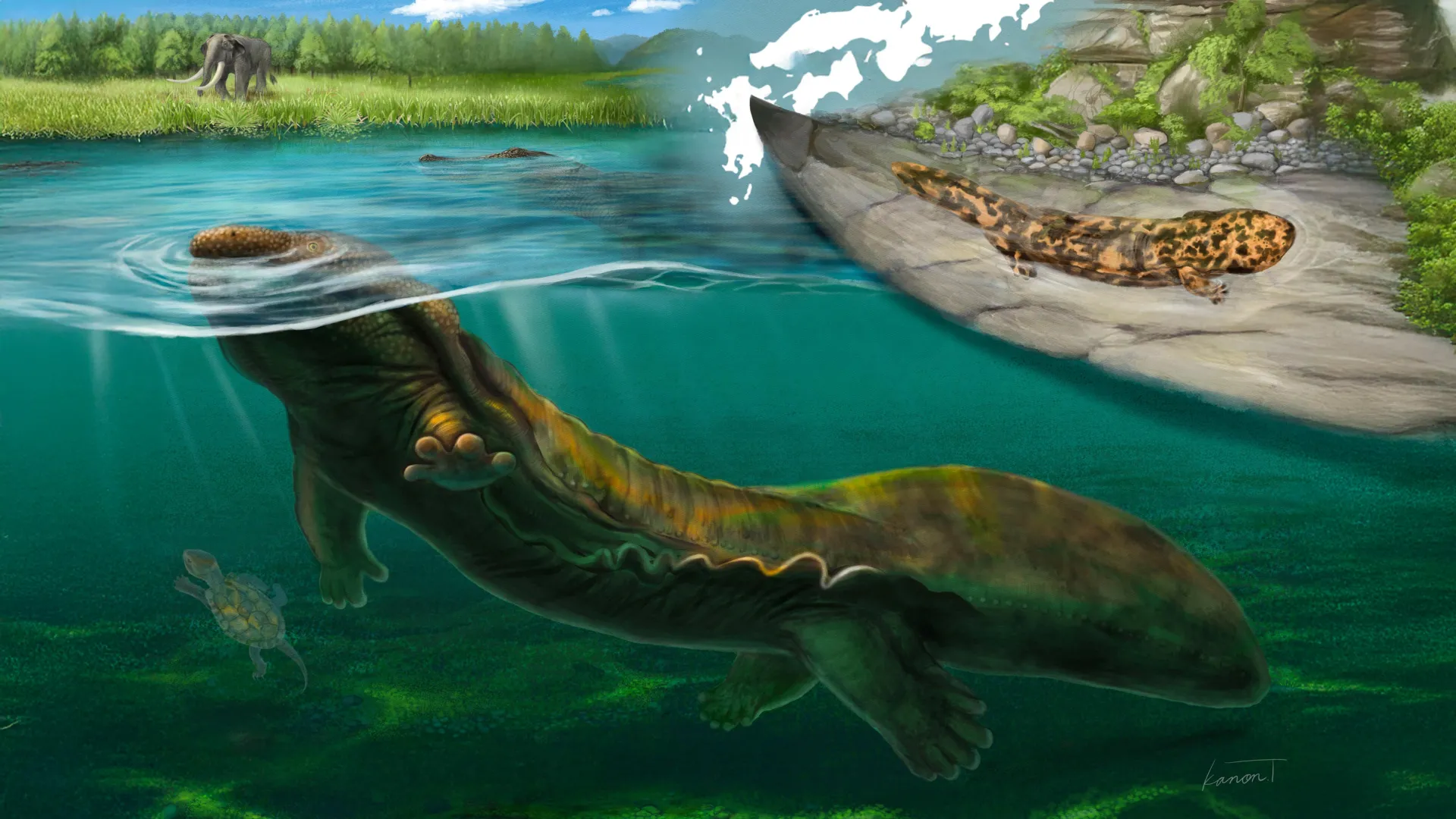
In the late 1990s, scientists working in the Ajimu area of Oita prefecture, Japan, uncovered three fossilized vertebrae from a giant salamander in the Cryptobranchidae family. The bones were preserved in the Tsubusugawa Formation, a layer of ancient lake sediments from the Pliocene dating to about 3.5 million years ago.
Other fossils found in the same formation include elephants and crocodiles, animals that are no longer native to Japan. Together, the remains point to a period when the region was considerably warmer and more humid than it is today.
At first, researchers placed the Ajimu fossils in the genus Andrias, which contains the largest amphibians alive today. However, scientists lacked enough comparative material and anatomical research to determine exactly what kind of giant salamander the bones represented.
More than 20 years later, a Kyoto University research team has returned to the fossils and uncovered new details about their identity.
A Salamander Unlike Any Known Species
The researchers compared the Ajimu bones with skeletons from living Cryptobranchidae species. Their analysis showed that the fossils consisted of an anterior trunk vertebra, a mid trunk vertebra, and a sacro-caudal vertebra.
The mid trunk vertebra was especially important because it contained anatomical features that do not appear in any other known member of the giant salamander family. Based on those differences, the team concluded that the fossils belonged to both a previously unknown species and a new genus.
"Ajimu contains the only site in the world where fossils of the giant salamander family and extant genera have both been found," says first author Masahiro Noda. "I'm delighted that this study has highlighted Japan as a crucial region for understanding their evolutionary history."
A Meter-Long Giant of Ancient Kyushu
The researchers named the species Limnospondylus ajimuensis. The name combines the Greek words limne, meaning lake, and spondylos, meaning vertebra, while ajimuensis refers to Ajimu.
This giant salamander lived in the broad freshwater lakes and marshes that covered parts of Kyushu several million years ago. As an adult, it may have reached approximately 1.1 meters in length.
Only five genera in the Cryptobranchidae family had previously been described, making the recognition of another genus an important addition to scientists' understanding of giant salamander diversity.
Cryptobranchidae fossils have been discovered throughout the Northern Hemisphere. However, limited anatomical knowledge has caused many specimens to be assigned to the living genus Andrias. The new findings raise the possibility that some of those fossils may actually represent numerous species that have yet to be recognized.
Climate Change and Extinction
Cooling temperatures during the shift from the Pliocene to the early Pleistocene, along with major changes in local habitats, may have contributed to the disappearance of Limnospondylus ajimuensis.
Its relative, Andrias japonicus, the Japanese giant salamander, still survives in rivers throughout the Ajimu region and elsewhere in Japan.
"Recently, Japan's native giant salamanders have faced challenges such as hybridization with foreign species and habitat destruction," says Noda. "This research has given me a renewed appreciation for the importance of preserving extant species for the future."