
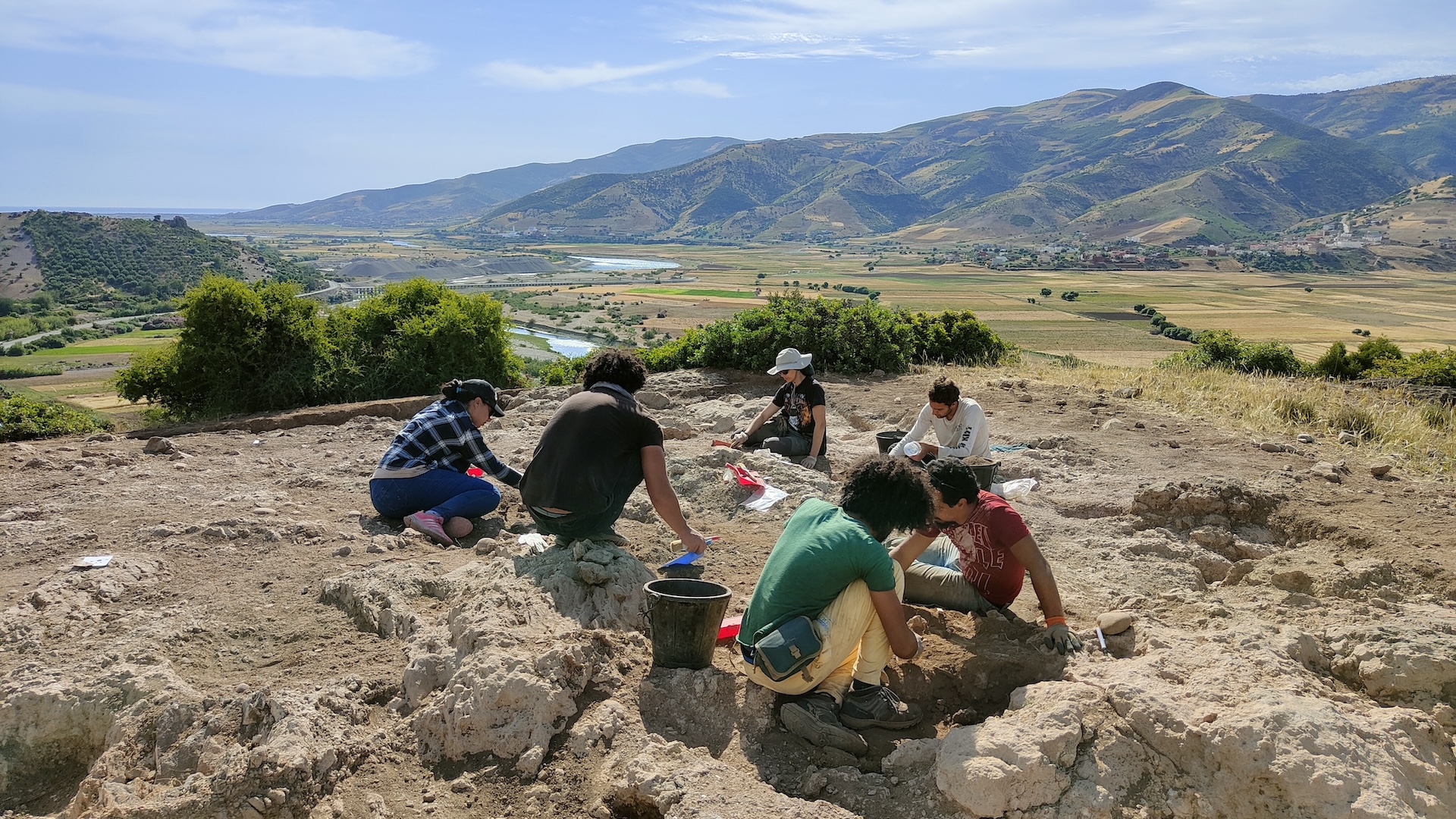
Archaeologists in Morocco have discovered the remains of a 4,200-year-old settlement that predates the Phoenicians — a surprise given that this region was thought to be uninhabited at that time.
The Phoenicians are famous for settling northern Africa and later battling Rome, but new excavations at the archaeological site of Kach Kouch reveal that northwestern Morocco was inhabited long before the Phoenicians arrived around 800 B.C.
The finds challenge "the notion of north-western Africa as terra nullius [uninhabited area] prior to Phoenician arrival," a team wrote in astudy published Feb. 17 in the journal Antiquity. The excavations also suggest that when the Phoenicians arrived, they didn't just take over the site. Instead, evidence indicates that ancient people there built houses using a mix of Phoenician and local architectural styles.
The earliest evidence for habitation at Kach Kouch dates to between 2200 and 2000 B.C., the researchers found. Archaeologists found three pottery shards, a cow bone and a chipped stone that may be from a stone tool. However, it's unclear if there was a permanent settlement at Kach Kouch at that point in time, study first author Hamza Benattia, a researcher at the University of Barcelona who led the excavations at the site, told Live Science.
The next phase of human habitation at the site started around 1300 B.C., when humans returned to Kach Kouch and turned it into a flourishing settlement. The archaeologists found the remains of houses, made using a technique called "wattle-and-daub." Houses built using this technique have a wooden frame known as a "wattle," with a sticky earthen material known as a "daub" filling out the walls.
Related: Rare gold coins and cremated infants were possible sacrificial gifts to the ancient gods of Carthage
Part of Kach Kouch's success at that time came from people growing a variety of crops, including barley, wheat, beans and peas. More than 8,000 animal bones were found, indicating that people were raising a variety of animals, including cattle, sheep and goats, the researchers said.
Image 1 of 2

Archaeologists excavate the 4,200-year-old site in Morocco.
Around 800 B.C., with the arrival of Phoenicians in the area, the site changed. Phoenician ceramics appeared at the site, and the architecture of the houses also evolved. Although people still built wattle-and-daub houses, they started building them on a stone base, known as a plinth, which is a Phoenician technique. This suggests that a "hybridization" of local and Phoenician culture occurred at the site, the team wrote in their paper. It's not clear if the site actually grew in size or what the Phoenicians themselves called it.
Kach Kouch was abandoned around 600 B.C., with no evidence of violence, the archaeologists wrote. New settlements were being established on the north coast of Africa at this time and it's possible that people moved to them, wrote researchers in their paper.
One Phoenician site that was growing in size was Carthage, located in Tunisia. Its people eventually fought a series of wars against the Roman Republic that led to Carthage's destruction in 146 B.C. As the Roman Republic spread across the Mediterranean, it took over Phoenician cities and towns across the region.