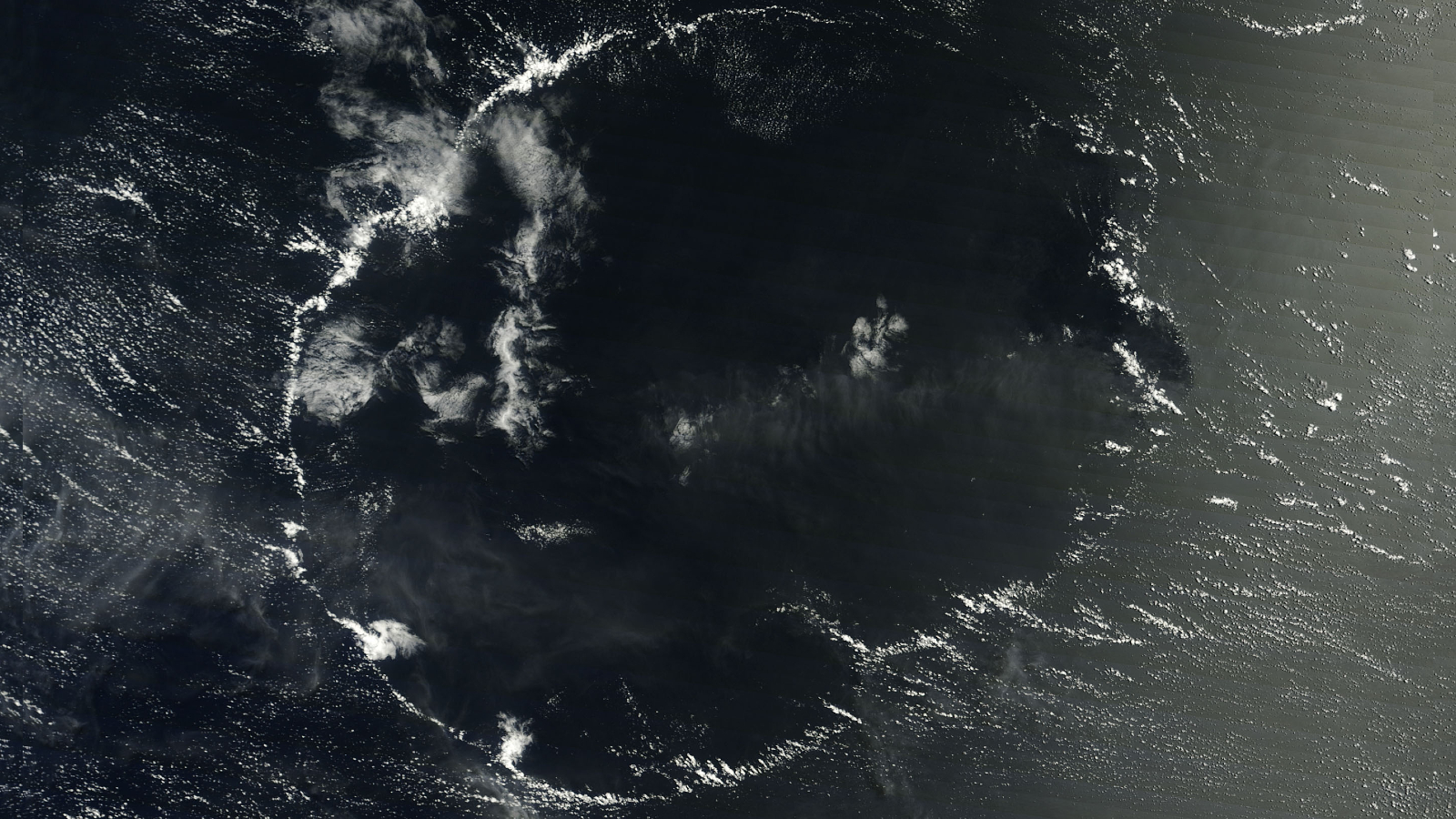
This striking satellite image reveals a giant, near-perfect cloud circle that formed in the heart of the Pacific Ocean more than a decade ago. While this type of cloud is not uncommon, it is extremely rare to find one isolated and in the middle of nowhere, experts say.
The strange structure, which is approximately 280 miles (450 kilometers) wide, was spotted "a few thousand kilometers southwest of the Hawaiian Islands" by the Moderate Resolution Imaging Spectroradiometer (MODIS) on NASA's Terra satellite, according to NASA's Earth Observatory.
The fluffy ring is made up of cumulus clouds that have been sculpted into a Rayleigh-Benard convection cell — a meteorological phenomenon powered by the rising and falling of air that's been warmed or cooled to different temperatures, known as convection.
There are two types of cloud cells: closed cells, which occur when cold air sinks around the cells' border, causing clouds to form at their centers; and open cells, which occur when cold air sinks at the cells' center, triggering clouds to form around their borders, according to the National Oceanic and Atmospheric Administration (NOAA). The cloud ring in the satellite photo was formed by a closed cell.
Cloud cells are normally hexagonal and usually appear alongside other cells of the same type, creating noticeable patterns in the sky. Open-cell clouds often form wispy honeycomb-like lattices, but for some reason, this cell appears to be all on its own.
Related: See all the best images of Earth from space

The lone cloud ring was likely triggered by a parcel of warm air over a small island or patch of water that was superheated by the sun, according to the Earth Observatory.
"As the warm air became buoyant and rose, cumulus clouds and eventually patches of light rain probably developed. The rain would have cooled the air beneath the clouds, causing a downdraft that sent rain-cooled air outward from the original location of the clouds," Earth Observatory representatives wrote. "When the rain-cooled air encountered warmer air at the edge of the cell, it likely pushed the warm air up, which caused the ring of cumulus clouds to form."
The cloud cell was located just south of the Intertropical Convergence Zone (ICZ) — a low-pressure belt near the equator where the trade winds trigger frequent thunderstorms and heavy rainfall. This may have also played a role in the cloud's creation, according to the Earth Observatory.
The ocean surface to the east (right) of the cloud ring appears to have a metallic shine. This is the result of a sunglint, where sunlight bounces off the sea and directly back to an observing instrument in space. This can transform large patches of the ocean into swirling silver mirrors.
Cloud cells were only discovered in 1961, thanks to images from NASA's Television Infrared Observation Satellite 1 (TIROS-1) satellite — the first full-scale weather satellite ever launched into space. Before then, the intricate patterns of the cells had gone largely unnoticed by meteorologists, according to the Earth Observatory.