
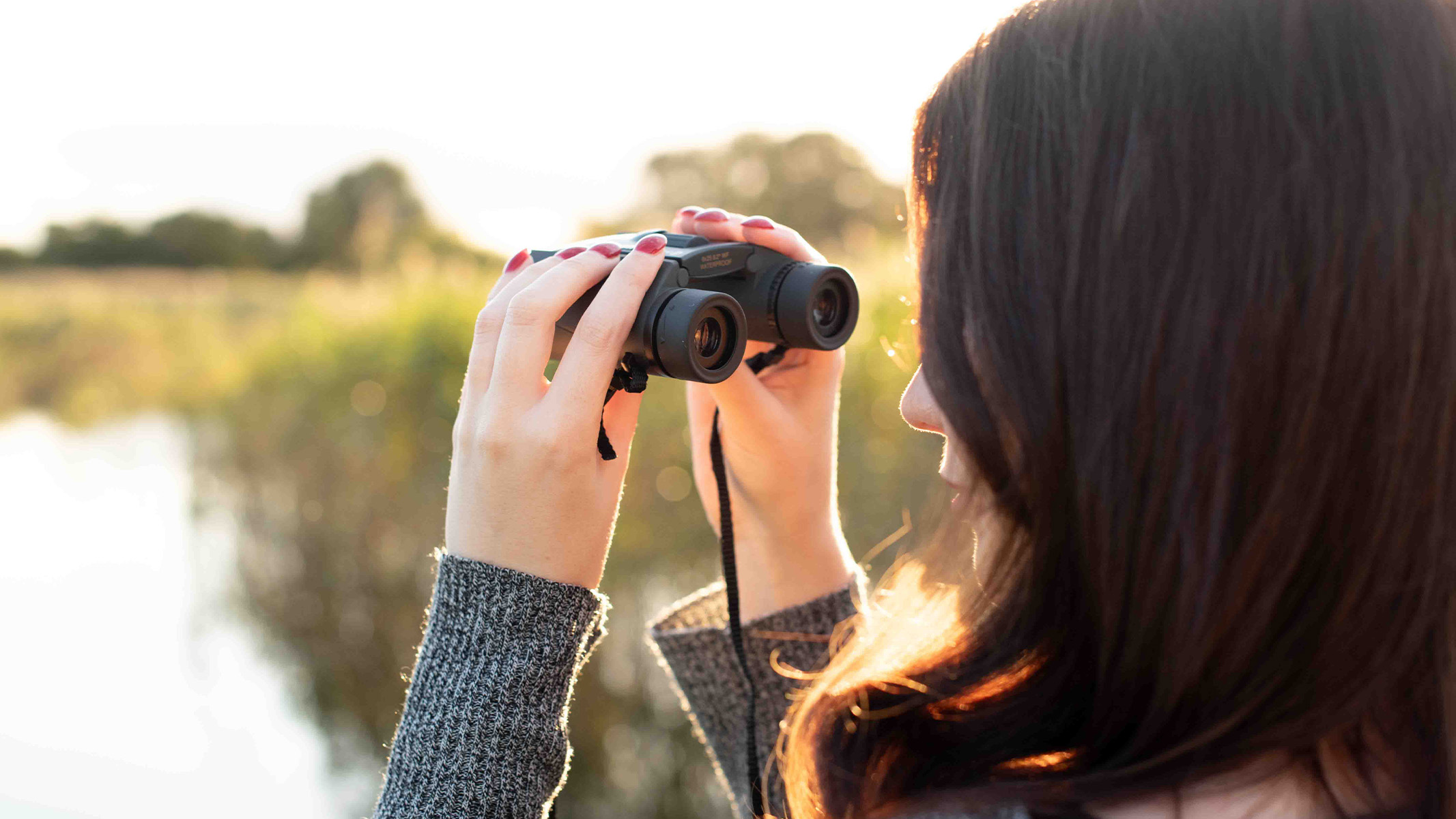
Binoculars are a fantastic way to get a closer look at the wonders of the natural world, but large, heavy optics can put people off. Some of the best binoculars can be pretty hefty, but there are plenty of small, lightweight binoculars that are ideal for slipping into your coat pocket or packing into your backpack for hikes, camping trips and family vacations.
Like many of the best binoculars for birdwatching, these compact binoculars are designed to be travel-friendly and easy to carry in your bag while still providing clear and detailed optical performance. The best binoculars for stargazing, however, tend to be bigger and heavier to let in more light.
The quick list
The best compact binoculars we recommend in 2025
Why you can trust Live Science Our expert reviewers spend hours testing and comparing products and services so you can choose the best ones for you. Find out more about how we test.
Best overall
Image 1 of 3

The Olympus 8x25 WP II are a solid choice for anyone looking for a pair of compact, waterproof binoculars that delivers sharp optics in a lightweight package but doesn't break the bank.
With an 8x magnification and 25mm objective lenses, they strike a good balance between portability and performance. During our Olympus 8x25 WP II review, we thought the optics were surprisingly good thanks to their class-leading BaK-4 porro prisms, as well as fully multi-coated optics to maximize the light transmission and sharpness.
While they may not have the largest objective lenses for low-light observations, they excel in daylight use, offering a great combination of clarity, durability and portability — we could comfortably fit them in the palm of our hand and hold them surprisingly steady despite their small size. Their rubber-coated body had a velvety feel and aided for a secure grip — we never felt like they were going to slip out of our hands.
Our only tiny gripe was that the small eyepiece covers are easy to misplace due to them being slip-on and unable to tether to the provided strap. Still, for the price, we think these binoculars are the perfect option for compact binoculars with a fantastic viewing experience.
Attributes | Notes |
|---|---|
Design | Soft rubber grip aids grip and comfort. |
Performance | Optics are better than expected. |
Functionality | Waterproof and fogproof. |
Best image-stabilized
Image 1 of 1
The Nikon 12x25 S stand out in the compact binocular market due to their electronic image stabilization, effectively reducing the hand shake that you often find with higher magnification, delivering a steady and clear viewing experience.
Weighing just 13.9 oz (395g) and measuring no more than 10cm on their longest edge, they are absolutely tiny and are fantastic for birdwatching and watching musicians or athletes from afar. Many of the best image-stabilized binoculars are big, heavy and bulbous, but the Nikon 12x25 S will easily fit into your pocket.
They're powered by two AA batteries, giving an approximate battery life of up to 12 hours — but don't worry, there's an auto-shut off feature that activates after 60 minutes of inactivity in order to preserve the battery life. A 10x25 variant is also available, but we'd recommend the 12x magnification pair in order to get the most out of the image stabilization.
If your budget can't quite stretch to these but you still want image stabilization, the Canon 10x20 IS are also fantastic and a little cheaper, but they are slightly bigger and heavier than the Nikon pair.
Attributes | Notes |
|---|---|
Design | Absolutely tiny. |
Performance | Ideal for birdwatching, traveling and hiking. |
Functionality | Image-stabilized for shake-free views. |
Best for stargazing
Image 1 of 3
Compact binoculars and the best binoculars for stargazing are somewhat opposites. The objective lenses need to be bigger in order to let all the light in when it's dark, and a higher magnification means more detailed views of distant objects. Both of these factors often result in a bigger, heavier pair of binoculars that are by no means considered "compact".
Typically, a 10x42 pair would be the minimum we would recommend for stargazing, so the Nikon Prostaff P7 10x42 likely won't be able to view deep-sky objects, but for impressive lunar views and sweeping views of the night sky, they're great. As far as stargazing binoculars go, the P7s are one of the most compact pairs you can get that will still have the magnification and objective diameter needed.
During our full Nikon Prostaff P7 10x42 review, we thought that the optics were fantastic, especially considering they don't have any of the special glass elements that higher-end binoculars have. We also loved the locking diopter wheel which prevents accidental defocusing while in use, and they are fully waterproof and nitrogen-purged to prevent fogging when moving between cold and warm environments.
Attributes | Notes |
|---|---|
Design | Locking diopter wheel prevents accidental defocusing. |
Performance | Optically fantastic. |
Functionality | Waterproof and fogproof. |
Best for kids
Image 1 of 3
The best binoculars for kids aren't always just a cheap toy: Some of them actually have pretty decent optics that the whole family can use. If you're looking for an inexpensive and durable pair of binoculars for your child, the Occer 12x25 are a great option as they typically only cost around $30.
During our full Occer 12x25 review, we thought that although they aren't suitable for low-light observation, and the optics weren't the best we've ever used, the views were sharp and pretty bright, though we did struggle to nail the focus at times. The interpupillary distance is also somewhat restrictive, so small kids or anyone with narrow-set eyes may struggle to get a perfect view without vignetting.
We also noticed some chromatic aberration, but that's not unexpected for the low price. To eliminate that completely, we're talking big bucks.
We thought they felt legitimately sturdy in the hand, and there's nothing fragile that can be broken off or damaged if kids were to handle them roughly. They're ideal for spotting birds in the back garden or taking on camping trips.
Attributes | Notes |
|---|---|
Design | Rugged, although interpupillary distance is restrictive. |
Performance | Good optics for the price. |
Functionality | Some chromatic aberration. |
Best midrange
Image 1 of 1
The Celestron TrailSeeker 8x32 ED are a very compelling option for outdoor enthusiasts looking for a pair of binoculars that offer portability without compromising on optical performance. They're designed to deliver bright, clear images in a compact form factor, making them ideal for birdwatching and taking on hikes.
The addition of the Extra Dispersion (ED) glass significantly reduces chromatic aberration, which appears as purple and green color fringing around highly contrasted areas, like trees against the sky. This results in a sharper image with increased clarity and color reproduction. Although we haven't reviewed this particular model, we have been continuously impressed with Celestron's optics.
Their impressive optics, combined with their waterproof and fogproof housing, make them some of the best binoculars for birdwatching when portability is a big factor. These features are typically found in higher-priced models, so we think that although they aren't necessarily that budget-friendly, they are fairly priced for what they can offer.
If you're looking for the next step up from your beginner pair of binoculars, they're a great option.
Attributes | Notes |
|---|---|
Design | Waterproof and fogproof. |
Performance | ED glass reduces chromatic aberration. |
Functionality | Tripod adaptable for longer sessions. |
Best premium
Image 1 of 1
All the Leica optics we've tested are a testament to their precision engineering and optical excellence, with binoculars that offer premium viewing in a compact form factor. But the Leica Ultravid 8x20 BR go a step further with their ultralight form at just 8.5 oz (240 g) — that makes them the most lightweight pair in this list.
Despite their small size, they deliver outstanding optical performance with sharp and vibrant images with excellent clarity and color reproduction. Users have reported minimal chromatic aberration — something we also noticed in our review of the larger Leica Ultravid 8x50 HD Plus model.
The 8x20 specs are ideal for keen wildlife observers who don't want to compromise on quality, but the 20mm objectives will be too small if you want to observe anything in low light, so they are best suited to daytime use.
While they come with an undeniably high price tag for such a small pair of binoculars, we think the investment is justified by the exceptional optics, durable construction and Leica's stellar reputation. If you're looking for high performance that will last a long time, they're definitely worthy of consideration.
Attributes | Notes |
|---|---|
Design | Ultralight construction. |
Performance | Exceptional Leica optics with minimal chromatic aberration. |
Functionality | Waterproof and fogproof. |
Best compact binoculars: comparison
Name | Magnification | Objective lens diameter | Eye relief | Weatherproof | Dimensions | Weight |
Olympus 8x25 WP II | 8x | 25mm | 15mm | Waterproof and fogproof | 4.49 x 4.53 x 1.77-inches (11.5 x 11.4 x 4.5 cm) | 0.63 lbs (285 g) |
Nikon 12x25 S | 12x | 25mm | 12.3mm | Not stated | 3.9 x 3.5 x 2.6-inches (10 x 8.9 x 6.5 cm) | 13.9 oz (395 g) |
Nikon Prostaff P7 10x24 | 10x | 42mm | 15.7mm | Waterproof & fogproof | 5.9 x 5.1-inches (15 x 13 cm) | 21.2 oz (601 g) |
Occer 12x25 | 12x | 25mm | 15mm | Waterproof | 4 x 4 x 4.4-inches (10.1 x 10.1 x 11.1 cm) | 8.8oz (249 g) |
Celestron TrailSeeker 8x32 ED | 8x | 32mm | 15.6mm | Waterproof & fogproof | 4.8 x 4.8 x 1.9-inches (12.3 x 12.2 x 4.8 cm) | 17.6 oz (499 g) |
Leica Ultravid BR 8x20 | 8x | 20mm | 15mm | Waterproof & fogproof | 4.4 x 3.7 x 1.5-inches / 111 x 93 x 39 mm | 8.5 oz (240 g) |
Compact binoculars: Frequently Asked Questions
What’s a good magnification for compact binoculars?
Compact binoculars tend to have smaller magnification and objective lenses to keep the size and weight down. 8x or 10x magnification are popular, and compact binoculars don't tend to have objectives much bigger than 42mm.
Which is more compact: porro or roof prism?
Roof prisms are more compact, as the internal layout of porro prisms makes them much bulkier.
What’s the best compact binocular for stargazing?
Stargazing and compact binoculars don't tend to overlap, but we named the Nikon Prostaff P7 10x42 as the best compact binoculars for basic stargazing.
What’s the best compact binocular for birdwatching?
Any of the binoculars in this list will be great for birdwatching, but the improved glass in the Celestron TrailSeeker 8x32 ED or the Leica Ultravid 8x20 BR will give that extra edge.
Which is better, 8x21 or 10x25 binoculars?
8x21 binoculars will be more compact and give a wider field of view, but 10x25 will have a bit of extra reach and let a little more light in.
Are compact binoculars good for kids?
Compact binoculars are great for kids as they might struggle to hold a larger pair steady enough. Many of the best binoculars for kids also have decent optics.
What are the best image-stabilized compact binoculars?
The Nikon 12x25 S are absolutely tiny and have image stabilization, as do the Canon 10x20 IS. These hold an advantage over most of the best image-stabilized binoculars as they are typically quite big and heavy.
How we test compact binoculars
Image 1 of 2
To test the best compact binoculars, we prioritize their comfort and portability when using them out in the field for both long and short periods to assess how easy they are to use, their optical performance and overall user experience.
As compact binoculars are much smaller than many of the best binoculars, we take note of how they compare in terms of interpupilarry distance, eye relief, how comfortable they are both to hold in the hand and carry around the neck, and the quality of any accessories they come with. Just because these optics are a lot smaller, doesn't mean they can get away with having less impressive optics.
We consider their intended use and our expert reviewes test them in real-world situations — as these compact binoculars are ideal for traveling, hiking and wildlife observation, we make sure to use them for such activities. There would be no use using a pair of 8x20s for stargazing and then reporting that they weren't very good, as that's not what they were designed for.