
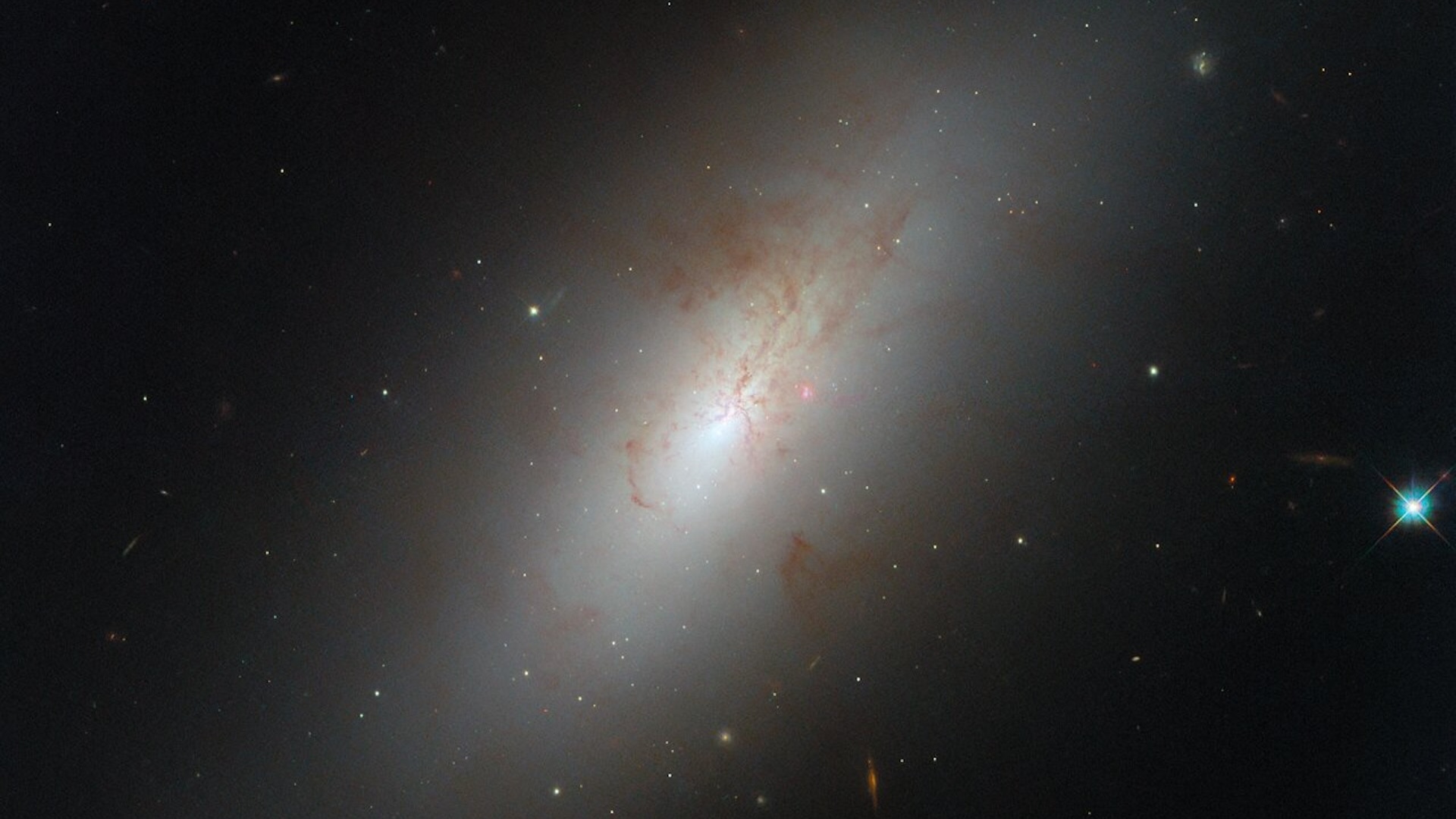
What it is: The galaxy NGC 4694, a member of the Virgo galaxy cluster
Where it is: 54 million light-years from Earth, in the constellation Virgo
When it was shared: Sept. 30, 2024
Why it's so special: NGC 4694 is a galaxy that cannot be easily classified into one of the two basic galaxy types: spiral and elliptical. Astronomers needed to examine its properties in detail to find its exact classification.
Spiral galaxies, such as our Milky Way, are relatively young and abundant in star-forming gas. They showcase distinct spiral arms adorned with hot, bright, young stars. In contrast, elliptical galaxies are more tranquil. These oval galaxies are composed primarily of older, redder stars. Most galaxies fall into these basic types.
However, NGC 4694 has properties of both types, complicating its classification, Hubble Space Telescope team members explained in a description of the image. It has a smooth-looking, armless shape, like an elliptical galaxy, and a disk with a low star-formation rate. However, it has relatively younger and newer stars forming in its central region. By contrast, elliptical galaxies do not typically contain the ingredients necessary for new stars to form. The active star formation, which powers the bright center, aligns more with the characteristics of a spiral galaxy. Like a young and lively spiral, NGC 4694 is rich in hydrogen gas and dust and is surrounded by a hydrogen gas cloud.

The image also features reddish-brown dust forming unusual structures scattered across the galaxy, spreading out from the core. Interestingly, the surrounding cloud of hydrogen gas forms a long bridge to a faint and tiny nearby galaxy named VCC 2062. An in-depth study of this image revealed that the two galaxies may have interacted in an intense collision, allowing the larger NGC 4694 to steal gas from the smaller VCC 2062. This dramatic collision shaped NGC 4694 into its unique armless, smooth form characterized by active star formation, classifying it as a lenticular galaxy.
Related: Researchers spot rare 'triple-ring' galaxy that defies explanation
Lenticular galaxies are intermediates between ellipticals and spirals. They feature a central bulge and a large disk, but they lack majestic spiral arms and contain more fuel for star formation than typical elliptical galaxies.
Using the Hubble Space Telescope, astronomers revealed the galaxy's classification. The stunning image is a result of combining ultraviolet data with optical data collected by Hubble's Wide Field Camera 3.
For more sublime space images, check out our Space Photo of the Week archives.